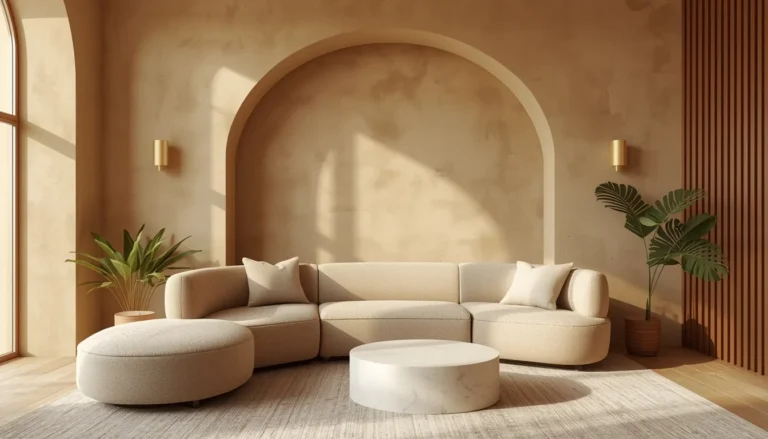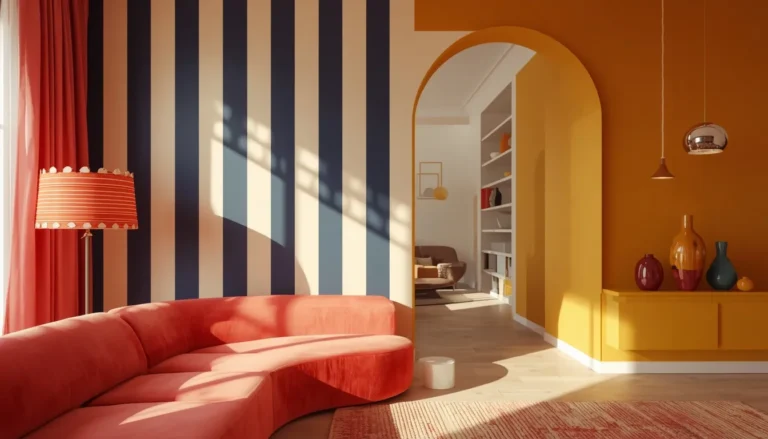
19 Neo Deco Living Room Ideas for a Modern Take on Art Deco Glam
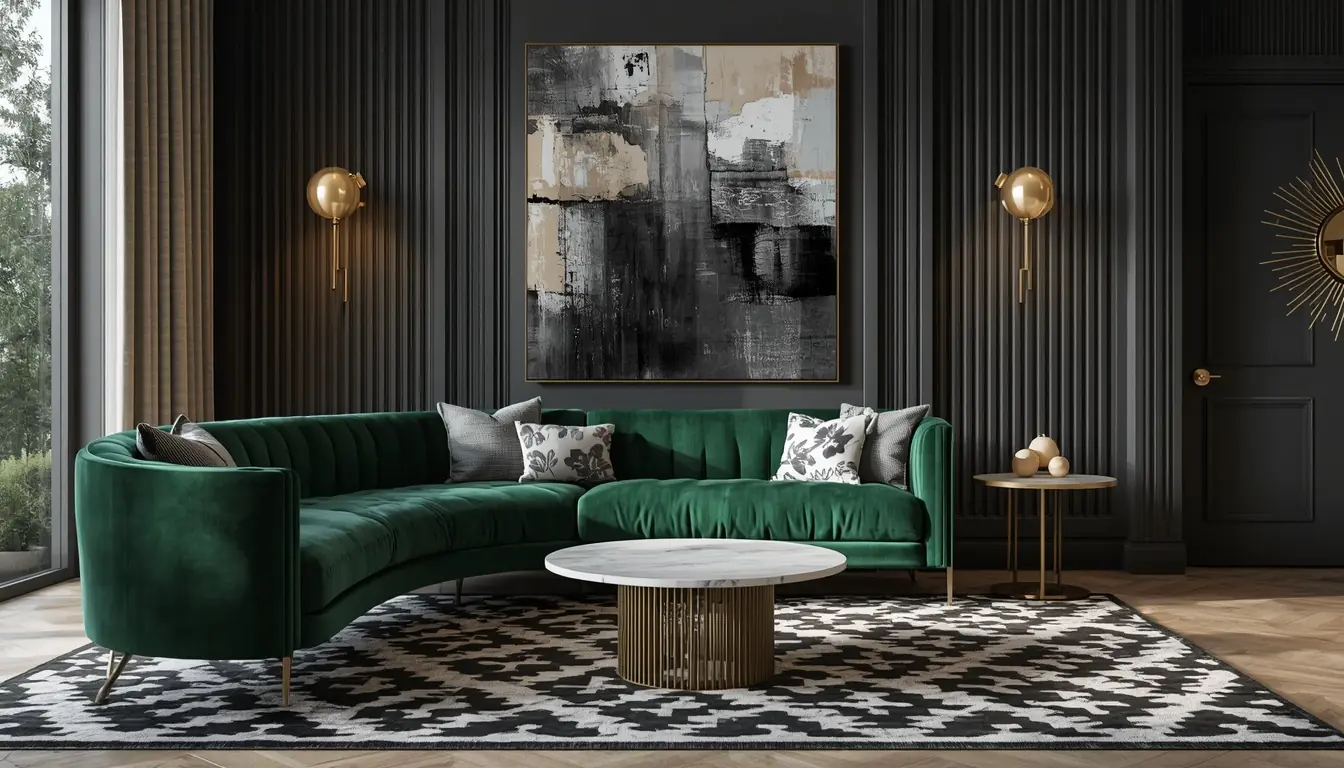
Art Deco never really left. It just spent a few decades waiting for someone to strip out the heavy lacquer and bring back the geometry with softer edges.
That’s essentially what Neo Deco is: the same 1920s vocabulary, sunbursts, fluting, stepped lines, jewel tones, warm metals, rebuilt for a room people actually want to sit in every day. The furniture curves instead of standing rigid. The colors show up in one or two confident places instead of covering every surface. The metal is warm brass or brushed gold, not gilded excess.
This list runs through 19 Neo Deco living room ideas, from a curved velvet sofa and fluted accent wall to renter-friendly swaps for anyone who can’t repaint or remodel, so you can build the look at whatever scale actually fits your space and your lease.
Table of Contents
1. Curved Velvet Jewel-Tone Sofa
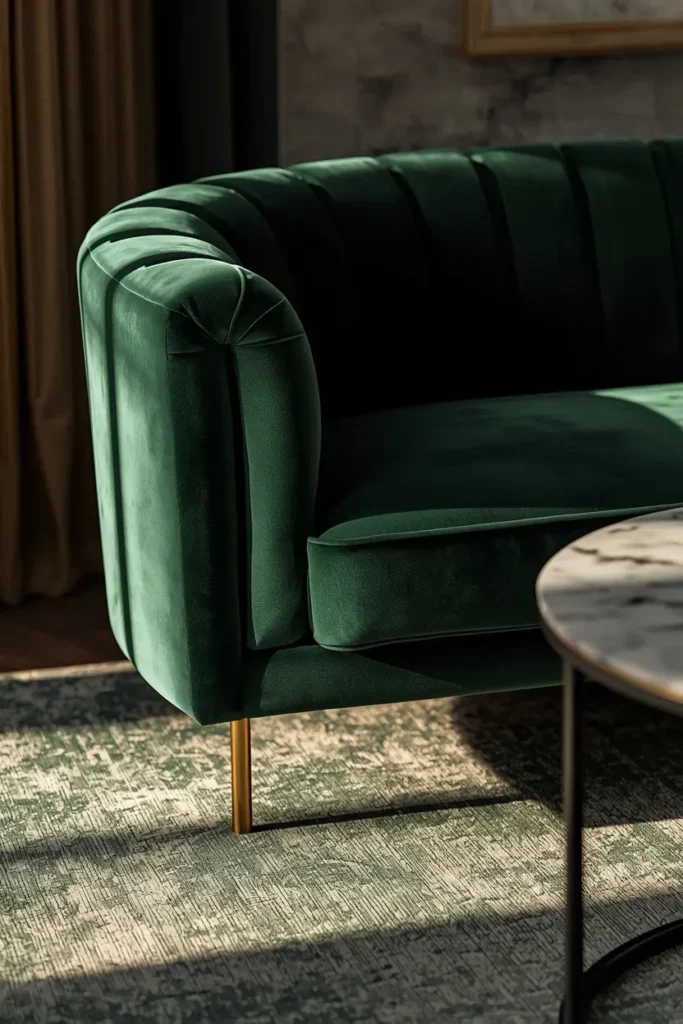
Choose a curved sofa upholstered in velvet, in a jewel tone like emerald, sapphire, or deep burgundy, as the anchor piece for a Neo Deco living room. The curve matters as much as the color here, since a sweeping, rounded silhouette is what separates Neo Deco seating from the boxier, more angular sofas found in a strictly traditional Art Deco reproduction. Velvet catches and holds light differently than flat cotton or linen upholstery, which adds real depth and richness to the piece even before anything else is styled around it. Pair the sofa with slim brass or gold metal legs rather than a heavy wood base, keeping the overall silhouette feeling current rather than like a period piece. Keep the rest of the room’s furniture relatively simple around this piece, since a bold curved sofa works best as a clear, uncontested focal point rather than one of several competing statement items.
2. Geometric Brass Coffee Table With a Stone Top
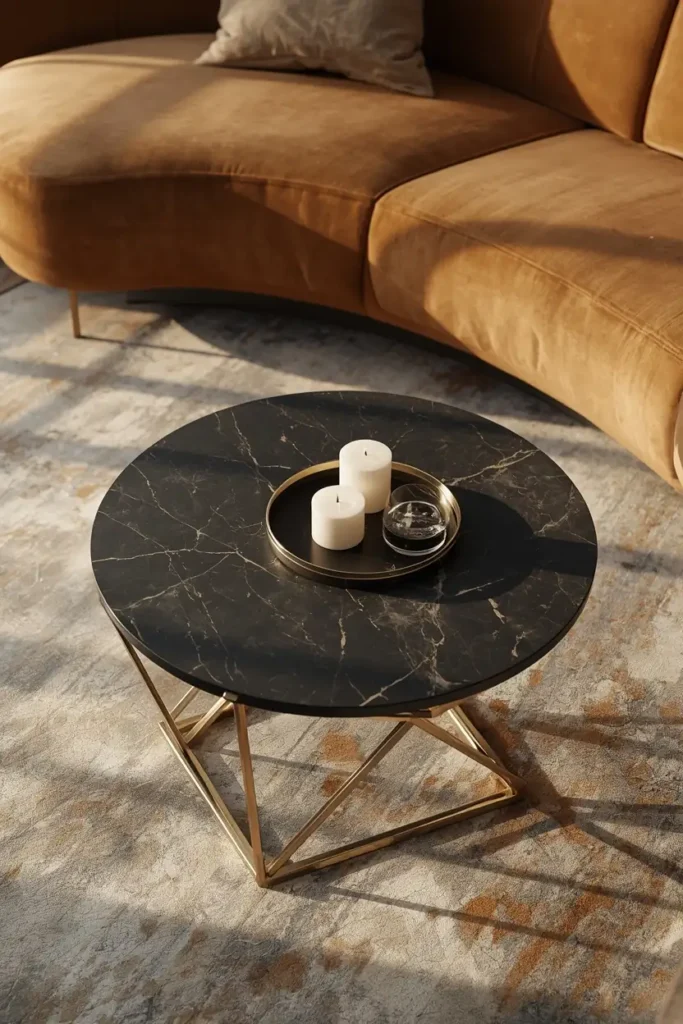
Choose a coffee table with a geometric brass or gold base, paired with a marble or dark glass top, to bring the room’s architectural personality down to a functional, everyday surface. The brass base introduces the angular, structured geometry Neo Deco is known for, while the smooth stone or glass top keeps the piece feeling sleek rather than overly ornate. This combination works especially well as a visual anchor placed directly in front of a curved sofa, since the table’s straighter lines create a deliberate contrast against the sofa’s rounded shape. Style the tabletop minimally, a tray, a small stack of books, or a single sculptural object, so the table’s own form stays visible rather than getting buried under decor. This idea works particularly well as one of the first furniture purchases in a Neo Deco room, since the coffee table sits at the literal center of the seating arrangement and sets the tone for everything placed around it.
3. Angular Bouclé Armchair as Contrast Seating
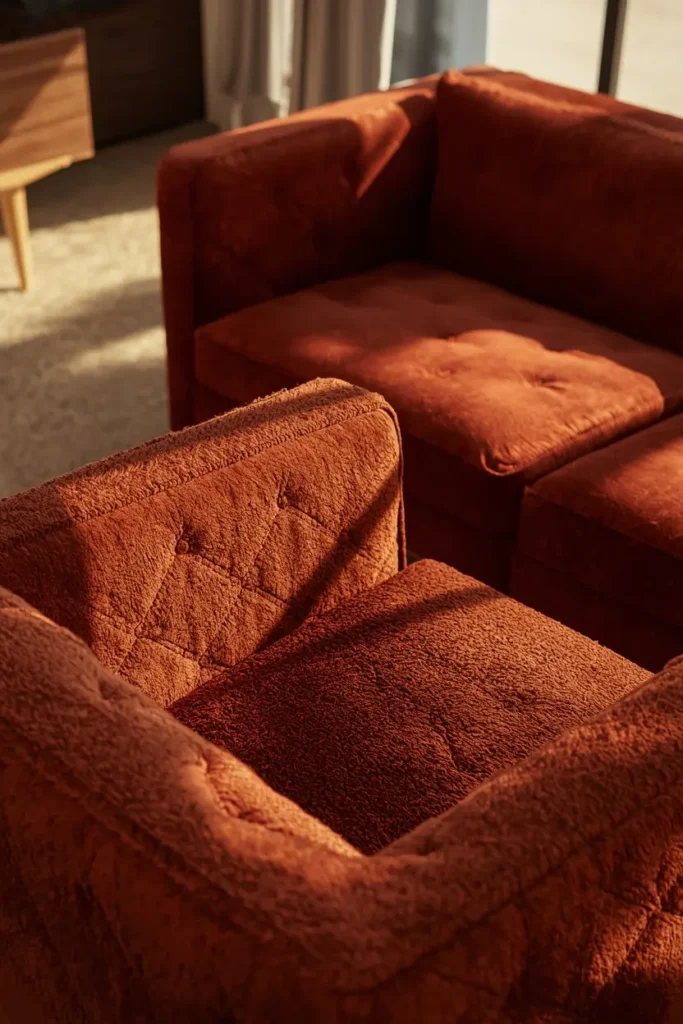
Pair the room’s curved sofa with an angular, boxy armchair upholstered in textured bouclé fabric, creating the deliberate tension between rounded and rigid shapes that makes Neo Deco seating arrangements feel dynamic rather than one-note. The chair’s sharper, more structured profile echoes the geometric details found elsewhere in the room, like a stepped molding or a fluted console, while the bouclé texture keeps the piece from feeling cold or overly severe. Choose a rich, warm tone for the chair, like rust, camel, or deep olive, so it complements rather than competes with a jewel-toned sofa nearby. Position the chair at an angle facing the sofa rather than squared off beside it, reinforcing the room’s overall geometry through furniture placement, not just individual pieces. This idea works particularly well for anyone who already owns a curved or rounded sofa and wants to add contrast without replacing the existing seating.
4. Burl Wood or Walnut Veneer Media Console
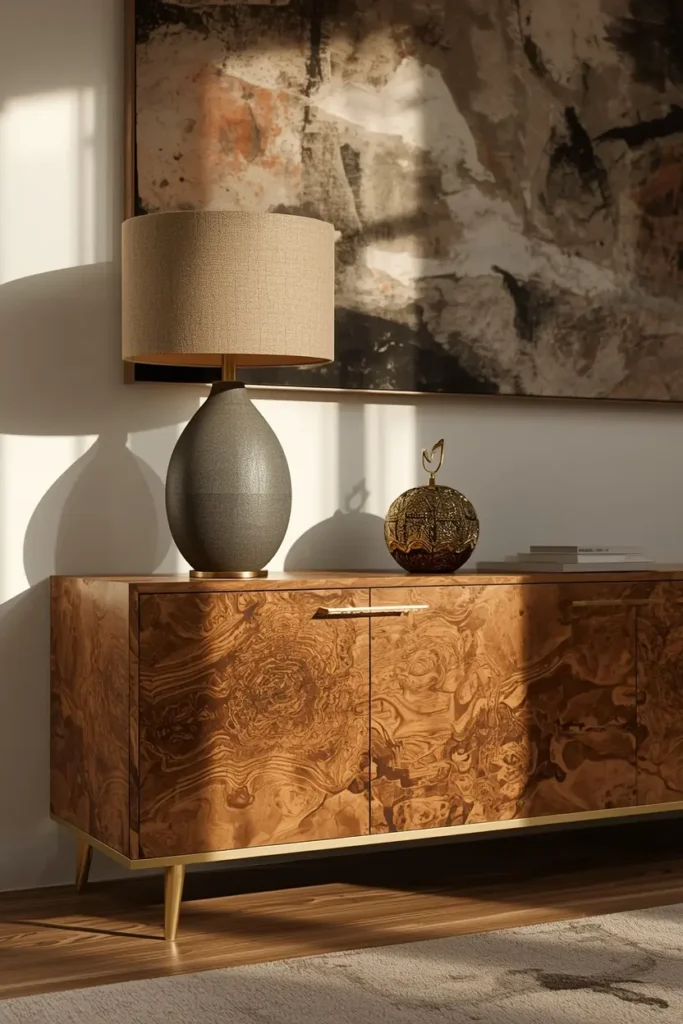
Choose a low media console or sideboard finished in burl wood or a richly patterned walnut veneer, letting the wood’s natural swirling grain function almost like an abstract pattern against the room’s smoother metal and stone surfaces. This detail adds genuine warmth and organic texture to a style that can otherwise lean heavily on cool marble and polished metal, preventing the room from feeling too slick or manufactured. Keep the console’s hardware minimal and geometric, a simple brass pull or a recessed handle, so the wood grain itself stays the visual focus rather than competing with ornate fixtures. Use the console for its actual function, storing media equipment or extra seating linens, while letting its surface hold a small styled vignette, a lamp, a sculptural object, or a stack of books. This idea works particularly well as a practical anchor for a media wall, since it solves real storage needs while still contributing meaningfully to the room’s overall aesthetic.
5. Fluted Wood Paneling Accent Wall
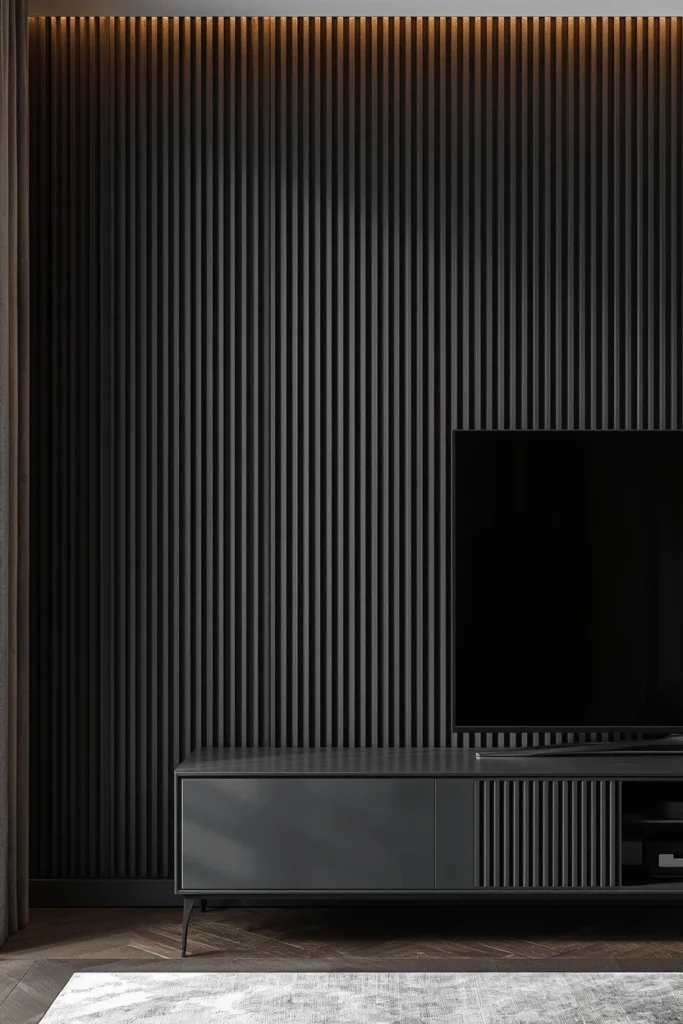
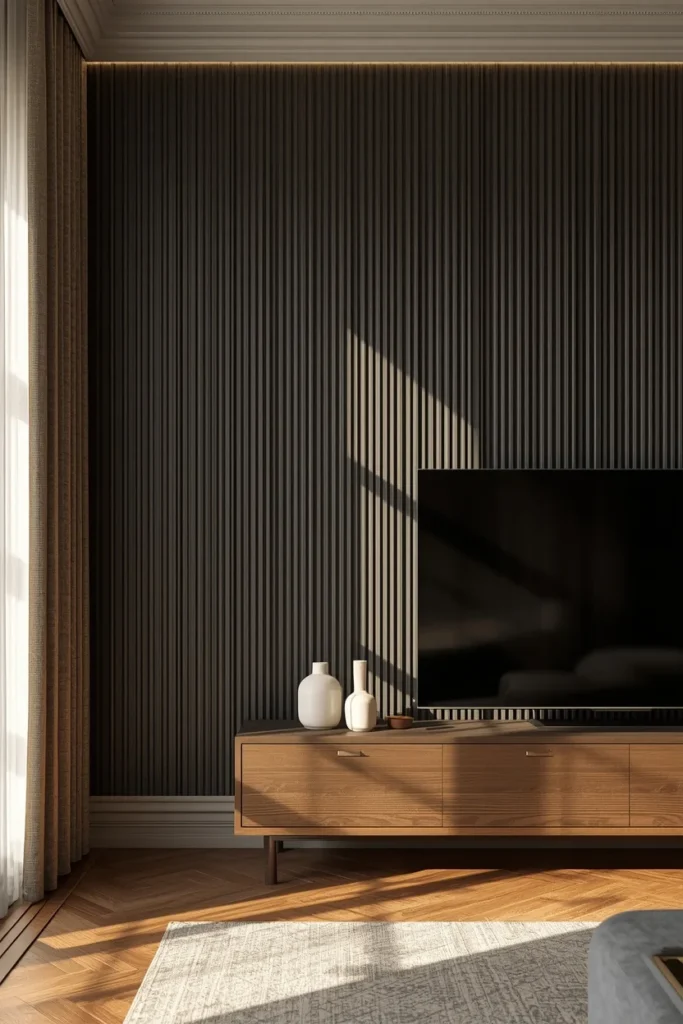
Install vertical fluted wood paneling on one accent wall, painted in a deep, moody color like charcoal, navy, or muted emerald, to add architectural texture without requiring heavy ornamentation. The repeating vertical grooves catch light and shadow differently throughout the day, creating a subtle rhythm across the wall that reads as considered and intentional rather than simply decorative. This treatment works especially well behind a media console, a sofa, or as a backdrop for a bar cart vignette, since the texture adds depth to whatever furniture sits in front of it. Paint the surrounding walls in a complementary, quieter tone so the fluted panel reads as a clear feature rather than one of several competing textures in the room. This idea requires more installation effort than most others on this list, but the architectural payoff is significant, since fluted paneling is one of the most immediately recognizable signatures of the Neo Deco aesthetic.
6. Stepped Skyscraper-Profile Molding
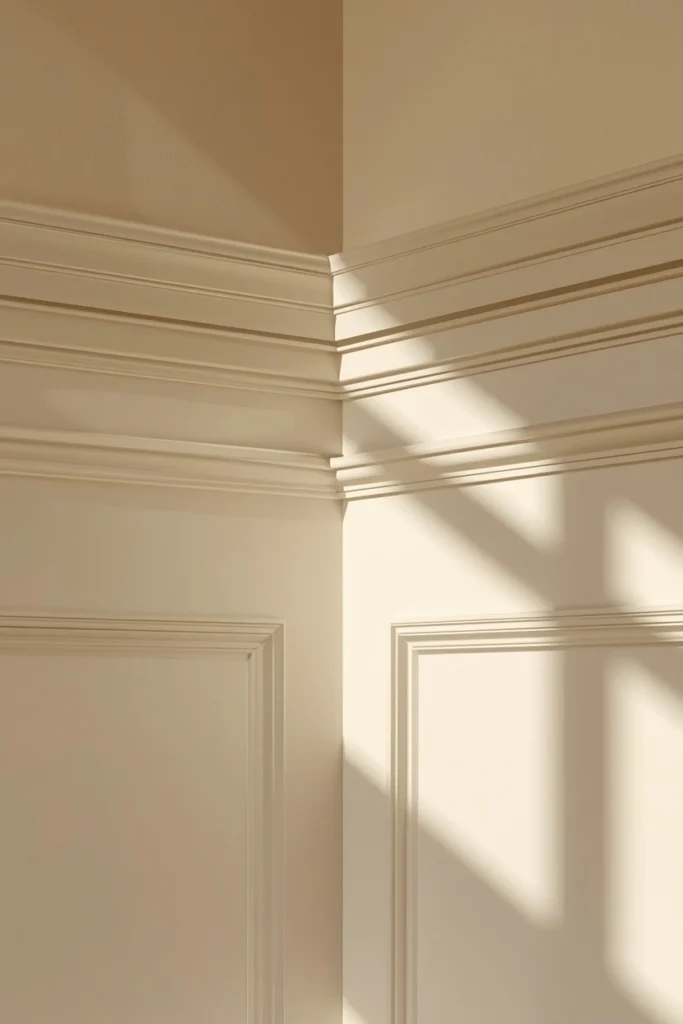
Update the room’s crown molding or baseboards with a stepped, tiered profile that echoes the iconic setback silhouette of 1920s skyscraper architecture, rather than a traditional rounded or flat molding style. This linear, layered detailing adds crisp shadow lines along the floor and ceiling that frame the entire room, even without any additional decor added on top of it. Paint the molding the same color as the surrounding walls to keep the look feeling modern and seamless, letting the shadows created by the stepped profile do the visual work instead of a contrasting paint color. This update works particularly well in a room with otherwise plain, builder-grade trim, since swapping the molding profile alone can noticeably elevate the space’s architectural character. This idea requires a contractor or experienced DIYer for proper installation, but it’s a foundational detail that quietly reinforces the Neo Deco theme throughout the entire room rather than in just one isolated spot.
7. Arched Doorway or Painted Archway Accent
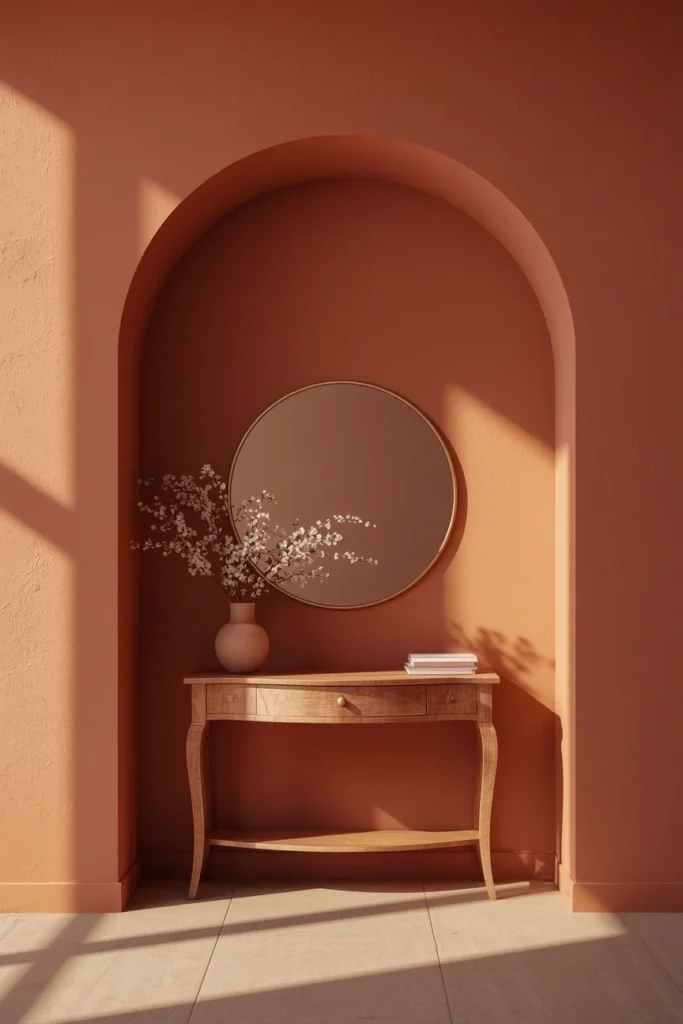
Introduce a curved architectural moment into the room through an arched doorway, or, if structural changes aren’t possible, a painted arch shape on a flat wall behind the sofa or a console table. Arches are one of Art Deco’s most enduring shapes, and repeating that curve somewhere in the room, even just as a painted silhouette, helps tie the space together visually alongside curved furniture pieces. Choose a contrasting paint color for the arch, like a deep terracotta or navy against a cream wall, so the shape reads clearly without needing any construction at all. Position curved furniture, like a rounded accent chair or an arched mirror, near the painted arch to reinforce the repeated shape throughout that part of the room. This idea works particularly well as a lower-cost alternative to structural arched doorways, since a painted arch delivers much of the same visual softening with only a can of paint and some careful measuring.
8. Globe Sconces Flanking Art or a Mirror
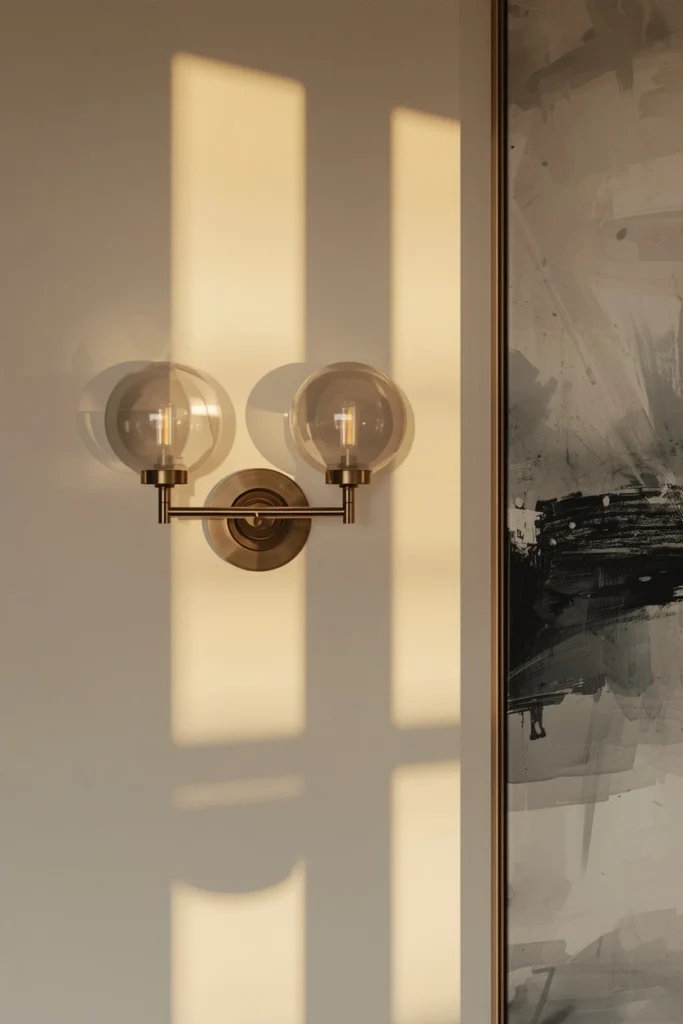
Mount a pair of globe-shaded sconces on brass or brushed gold backplates, positioned symmetrically on either side of a piece of art, a mirror, or a media wall. The simple spherical shade paired with a sharp linear backplate creates a small but effective contrast of shapes, a hallmark of the Neo Deco lighting approach, while providing genuinely useful ambient light beyond just overhead fixtures. Choose a warm-toned bulb so the glow feels inviting rather than clinical, especially since sconces are often used for evening ambiance rather than bright daytime task lighting. Symmetrical placement matters here more than with most other decor choices, since a pair of matched sconces reinforces the balanced, considered layout Neo Deco rooms tend to favor. This idea works particularly well as a secondary light source layered alongside a floor lamp or overhead fixture, since Neo Deco rooms typically rely on multiple light sources at different heights rather than one single bright source.
9. Tiered Glass or Brass Statement Chandelier
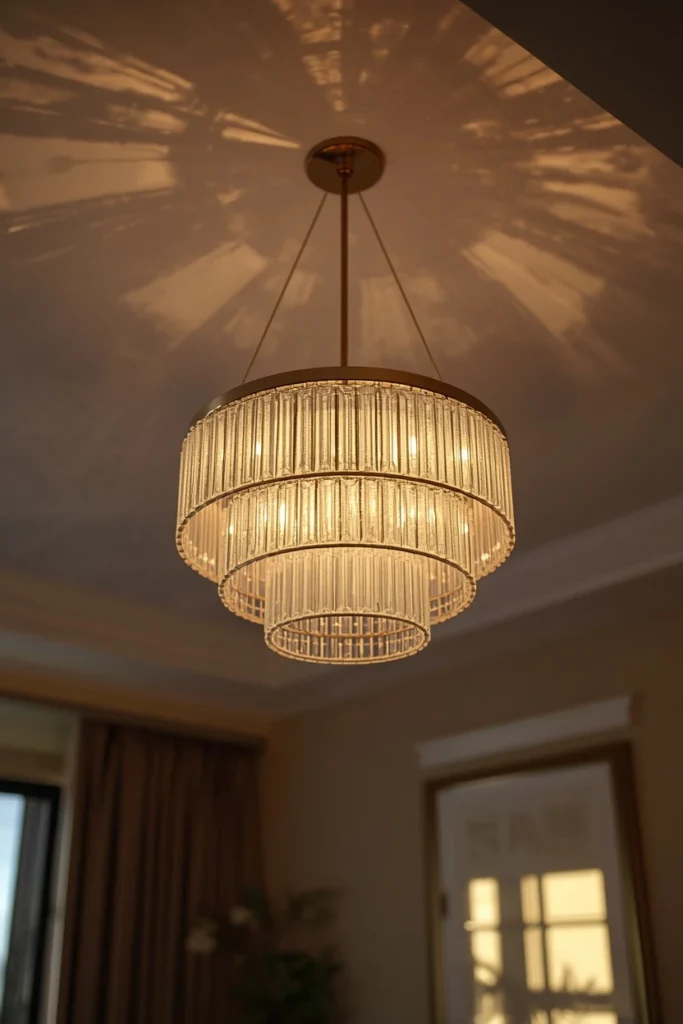
Hang a chandelier with staggered tiers of glass rods or geometric brass arms as the room’s central overhead fixture, giving the space a clear, dramatic focal point from above. A tiered design provides real vertical scale and texture without relying on traditional crystal drops or elaborate scrollwork, which keeps the fixture feeling current rather than like a literal period reproduction. Choose frosted or ribbed glass elements if available, since the diffused light they cast tends to feel warmer and less harsh than fully clear glass or exposed bulbs. Size the fixture appropriately for the room, since an undersized chandelier can get lost in a larger living room while an oversized one can overwhelm a smaller space. This idea works particularly well as one of the last additions to a Neo Deco room, since the chandelier should complement furniture and wall treatments that are already largely finalized rather than dictate the rest of the room’s scale.
10. Layered Lighting Plan Across Three Heights
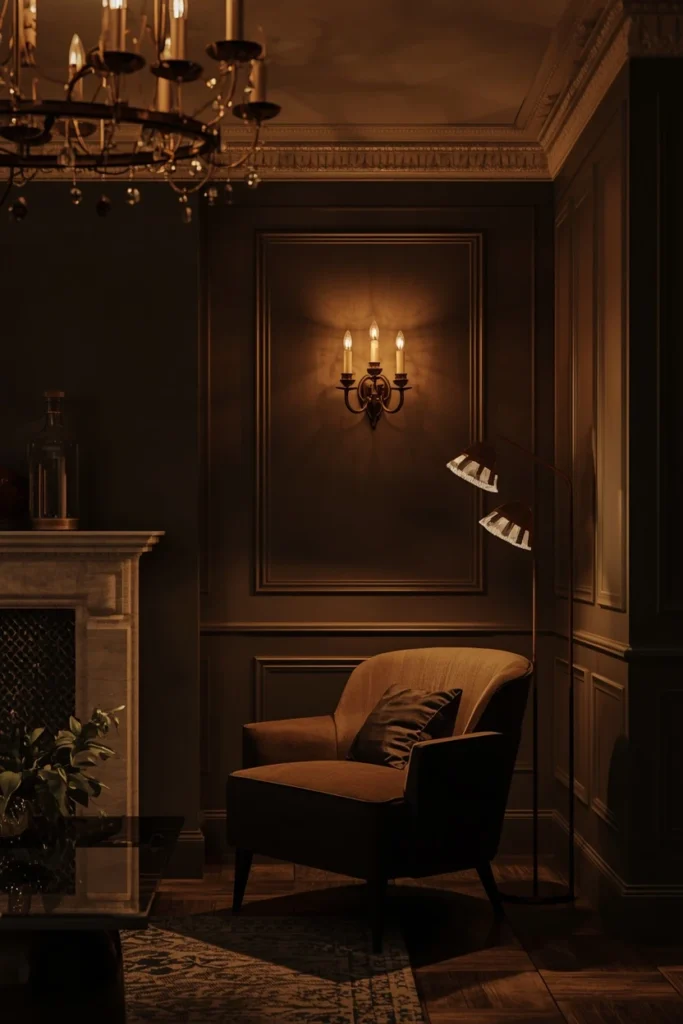
Plan the room’s lighting across three distinct heights, overhead (a chandelier or flush mount), mid-level (wall sconces or picture lights), and low (a floor lamp with a sculptural base or a table lamp), rather than relying on a single overhead fixture alone. This layered approach does more than any individual lighting piece to create the moody, glamorous atmosphere Neo Deco rooms are known for, since multiple light sources at different heights eliminate harsh shadows and add real dimension to the space. Choose a consistent warm color temperature across all three levels, since mixing warm and cool bulbs within the same room can undercut an otherwise well-planned lighting scheme. Position a floor lamp with a sculptural, geometric base near a reading chair or the end of the sofa, giving that lower light layer its own Neo Deco detail rather than treating it as purely functional. This idea works as a planning framework more than a single purchase, and it’s often the difference between a room that photographs well in daylight but feels flat at night, and one that holds its glamorous mood at any hour.
11. Black and Gold High-Contrast Wall
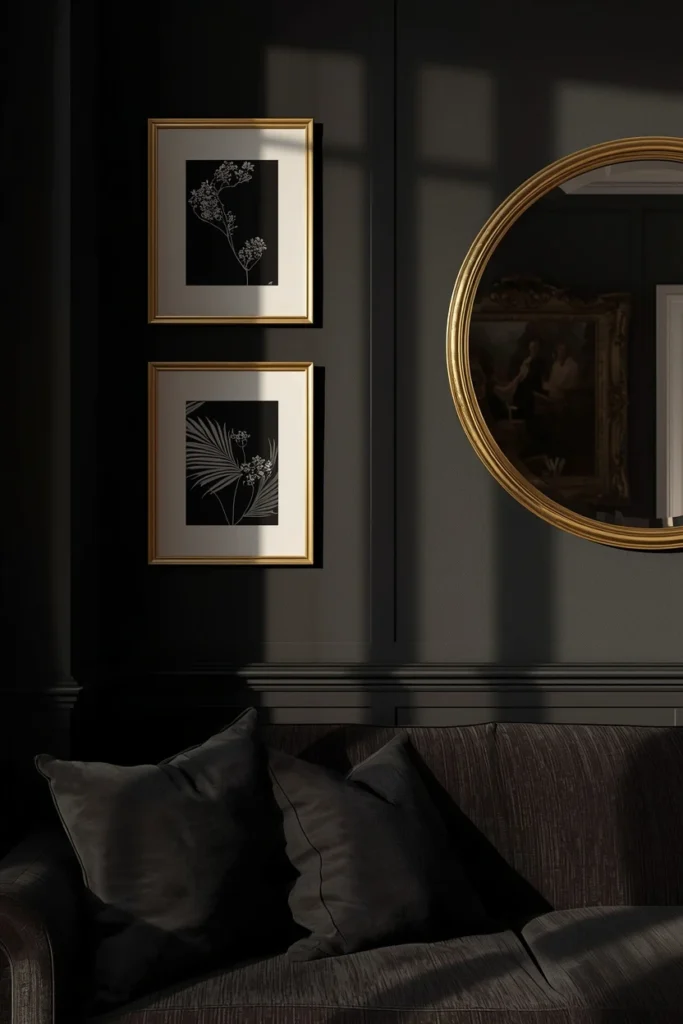
Paint one wall, or a portion of it, in matte black, then pair it with brushed gold picture frames, lighting, or hardware for one of the boldest, most immediately recognizable Neo Deco color combinations. This high-contrast pairing feels dramatic without needing much additional decor, since the sheer color and metal contrast does most of the visual work on its own. Soften the intensity of the black and gold pairing with plush, textured seating nearby, like a velvet cushion or a patterned rug, so the room doesn’t feel purely sharp and cold. Keep this treatment contained to one wall or a clearly defined section of the room, since a fully black-and-gold living room can quickly feel heavy rather than glamorous. This idea works particularly well as a backdrop for a media wall or a piece of statement art, since the dark background makes both lighter furniture and metallic accents nearby appear to glow by comparison.
12. Jewel Tone Feature Wall
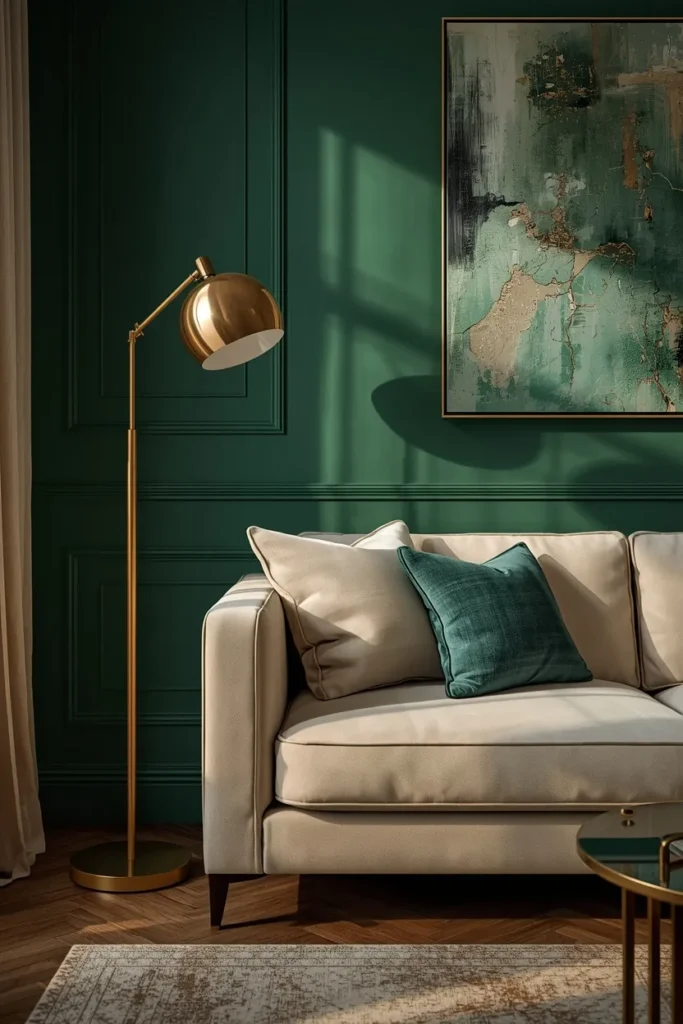
Paint a single feature wall in a deep jewel tone, like emerald, plum, sapphire, or rich teal, to bring dramatic color and warmth into the room without overwhelming every surface. These saturated hues pair naturally with warm metallic accents and plush textures, reinforcing the glamorous, intimate mood Neo Deco rooms are going for. Balance the bold wall color with lighter furniture nearby, like a cream or ivory sofa, or with glass and metal tables, so the room doesn’t feel too dark or heavy overall. Layer in metallic decor and velvet textiles throughout the space to echo the wall color’s richness without repeating the exact same shade everywhere. This idea works particularly well as one of the lowest-cost, highest-impact updates on this list, since a single gallon of quality paint can transform an entire room’s mood in a single weekend.
13. Layered Mixed Metal Finishes
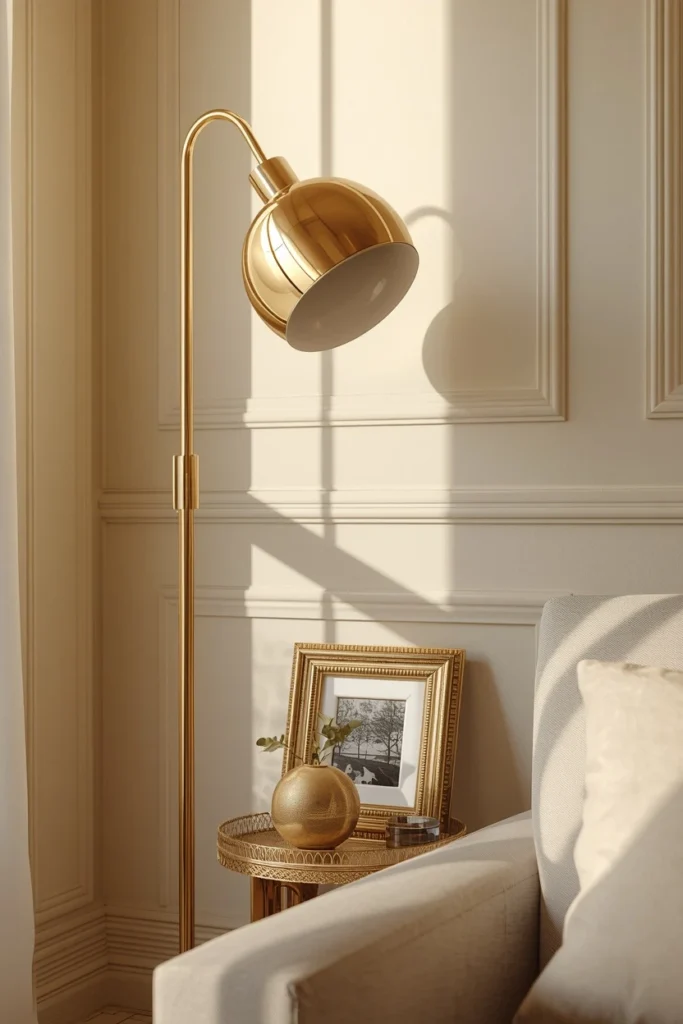
Combine brass, gold, and chrome throughout the room’s lighting, hardware, and decor, choosing one dominant metal and using the others as smaller accents rather than mixing all three in equal amounts. This layering technique adds genuine dimension and richness when handled thoughtfully, since a single metal finish throughout an entire room can start to feel flat, while multiple competing finishes without a clear hierarchy can feel chaotic. Introduce the secondary and accent metals through smaller items, a chrome picture frame here, a gold candle holder there, rather than large furniture pieces, which helps keep the dominant metal clearly in charge of the room’s overall metallic tone. Pair the mixed metals against a neutral backdrop, like cream or charcoal walls, so the reflective surfaces catch and scatter light clearly rather than competing with a busy wall color. This idea works particularly well in a room that already has one strong metal element, like brass sofa legs or a gold-framed mirror, giving you a clear starting point for which metal should lead.
14. Marble Plinth as Sculptural Pedestal
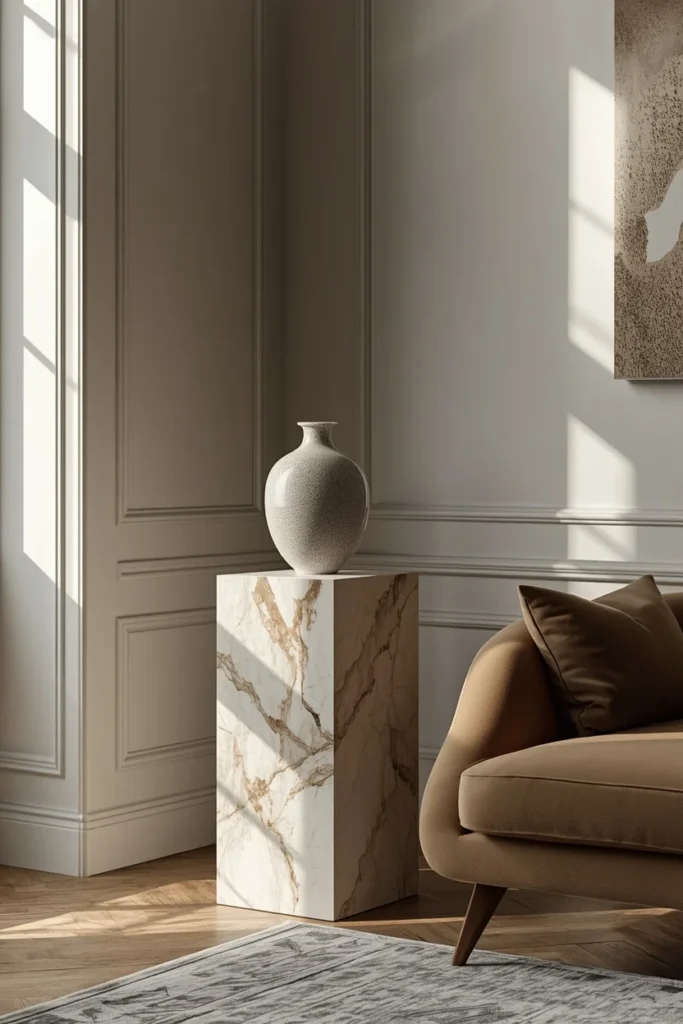
Use a solid marble plinth or pedestal as a stand for a plant, sculpture, or decorative object, bringing a sense of gallery-like permanence into the room that a typical side table can’t quite replicate. The heavy, unyielding quality of the stone contrasts beautifully against softer velvet seating and delicate glass accessories nearby, adding a sense of weight and intentionality to the vignette. Choose a marble with visible, dramatic veining for extra organic pattern, or a plainer honed finish if you want the plinth’s shape to carry more of the visual interest than its surface pattern. Position the plinth somewhere it can be viewed from multiple angles, like a corner near a window or beside a sofa’s armrest, since its sculptural quality is part of what makes it worth featuring prominently. This idea works particularly well for displaying a single striking object, since the plinth’s minimalist form is designed to support one clear focal piece rather than a cluttered grouping.
15. Sunburst Mirror Opposite a Window
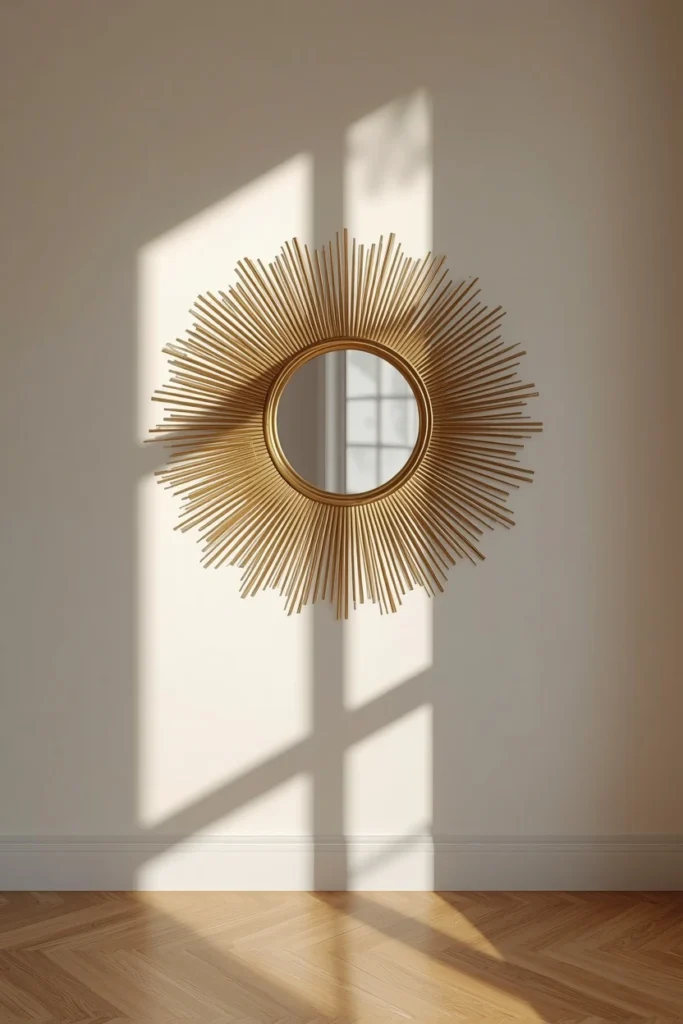
Hang a sunburst mirror, with metallic rays radiating outward from a central glass disc, on the wall directly across from the room’s main window. This placement isn’t just decorative, since positioning the mirror to catch and bounce natural light back across the room can genuinely make the space feel brighter and larger throughout the day. The radiating metal rays are one of Art Deco’s most recognizable motifs, and a sunburst mirror functions as both a light-enhancing tool and a piece of wall art in its own right, reducing the need for additional decor on that wall. Choose a gold or black finish depending on whether you want the mirror to read as warm and glowing or bold and graphic against the surrounding wall color. This idea works particularly well in a smaller living room or one with limited natural light, since the mirror’s dual function of reflecting light and adding visual interest does real practical work beyond styling alone.
16. Glass and Brass Bar Cart Vignette
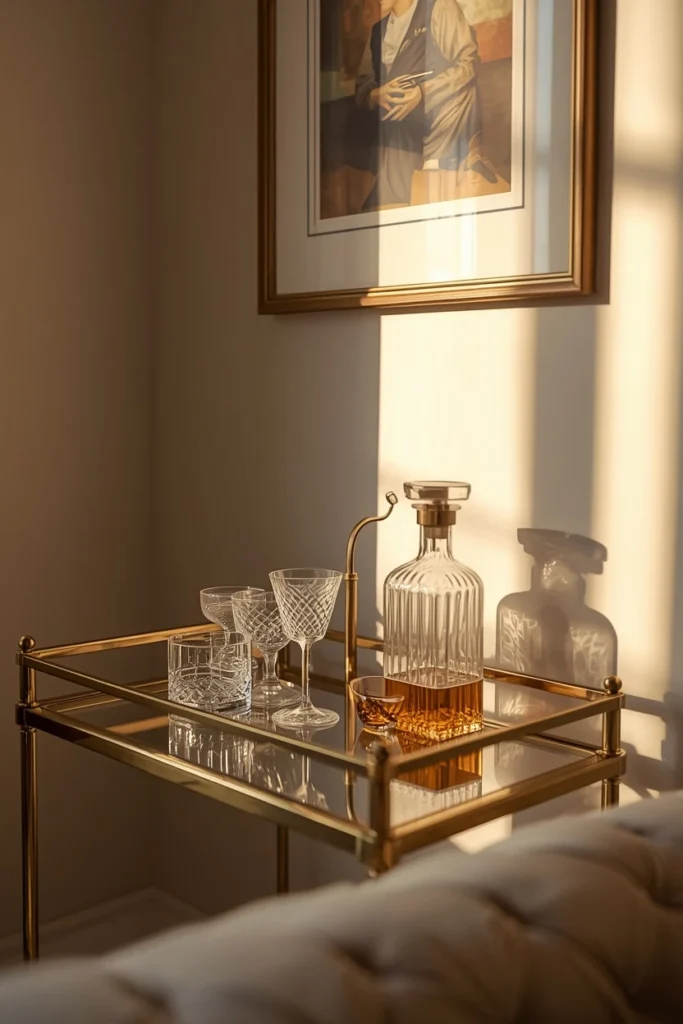
Set up a glass and brass bar cart near the seating area, styled with crystal glassware, a decanter, and a small piece of art or a plant on the shelf above it. The transparency of the glass keeps the piece visually light even within a fairly small footprint, while the brass framing adds warmth and a touch of vintage glamour without requiring a full cabinet or dedicated furniture piece. Keep the styling on the cart relatively minimal, three or four items at most, so it reads as a curated vignette rather than cluttered storage. Position the cart somewhere it functions practically, near enough to the seating area for actual use during a gathering, rather than treating it purely as a decorative prop tucked into an unused corner. This idea works particularly well as a smaller, lower-commitment way to introduce Neo Deco style into a room, since a bar cart requires far less investment or space than a new sofa or a full accent wall.
17. Peel-and-Stick Fluted Panels for Renters
Apply peel-and-stick fluted or reeded wall panels to a single accent wall, getting the same vertical texture and shadow play as built-in wood paneling without any permanent installation or wall damage. This idea works especially well for renters or anyone hesitant to commit to a full remodel, since most peel-and-stick paneling options remove cleanly and leave the wall in its original condition underneath. Choose a panel finish in a deep, moody tone if available, or paint an existing lighter panel yourself using an exterior-grade paint suited to the panel’s material. Apply the panels to a clean, dry wall following the product’s specific instructions, since proper surface prep significantly affects how well the adhesive holds over time. This idea proves that some of Neo Deco’s most defining architectural details, the ones that seem to require construction, can actually be achieved with a rental-friendly product and an afternoon of careful installation.
18. Deco-Tropical Rattan and Cane Accent Chair
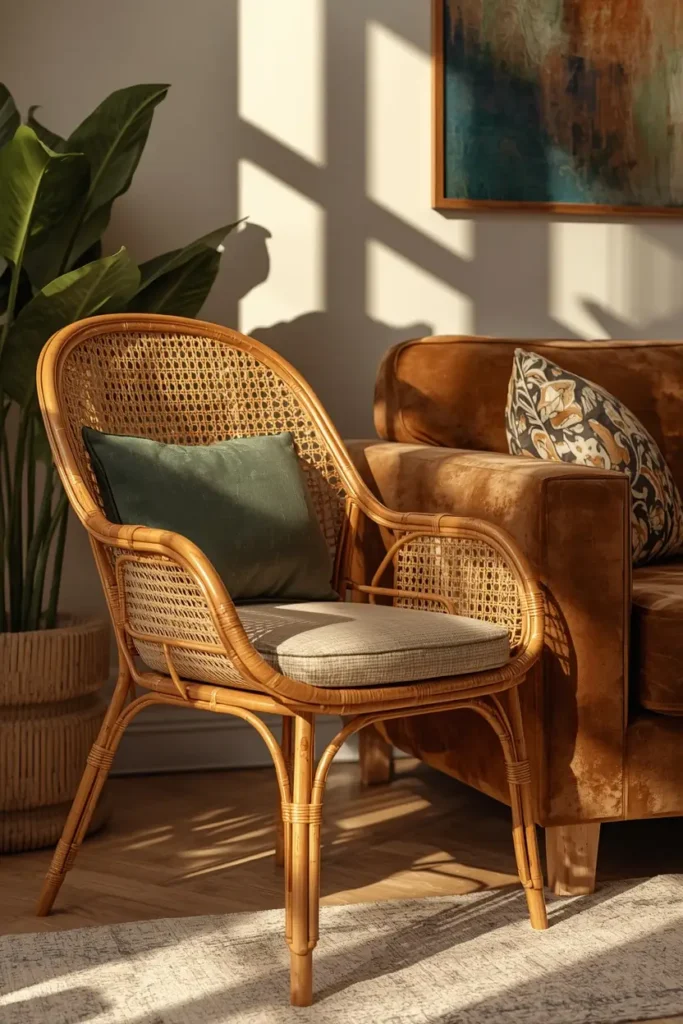
Introduce a woven rattan or cane-backed accent chair into an otherwise glamorous Neo Deco room, blending in a lighter, more organic material against the style’s usual velvet, marble, and brass. This combination, sometimes called Deco-tropical, softens the room’s overall formality and adds a warm-weather, slightly bohemian note without abandoning the geometry and symmetry that define the broader style. Choose a chair with a curved or fan-shaped cane back, echoing the same rounded silhouettes found in a curved sofa or an arched doorway elsewhere in the room. Pair the rattan piece with a solid-colored cushion in a jewel tone or warm neutral, keeping the woven texture from feeling out of place against smoother velvet and stone surfaces nearby. This idea works particularly well for anyone who finds a fully polished, all-metal-and-marble Neo Deco room a little too formal, since the rattan detail brings genuine warmth and a slightly more relaxed, livable feel.
19. Symmetrical Layout Anchored by One Focal Point
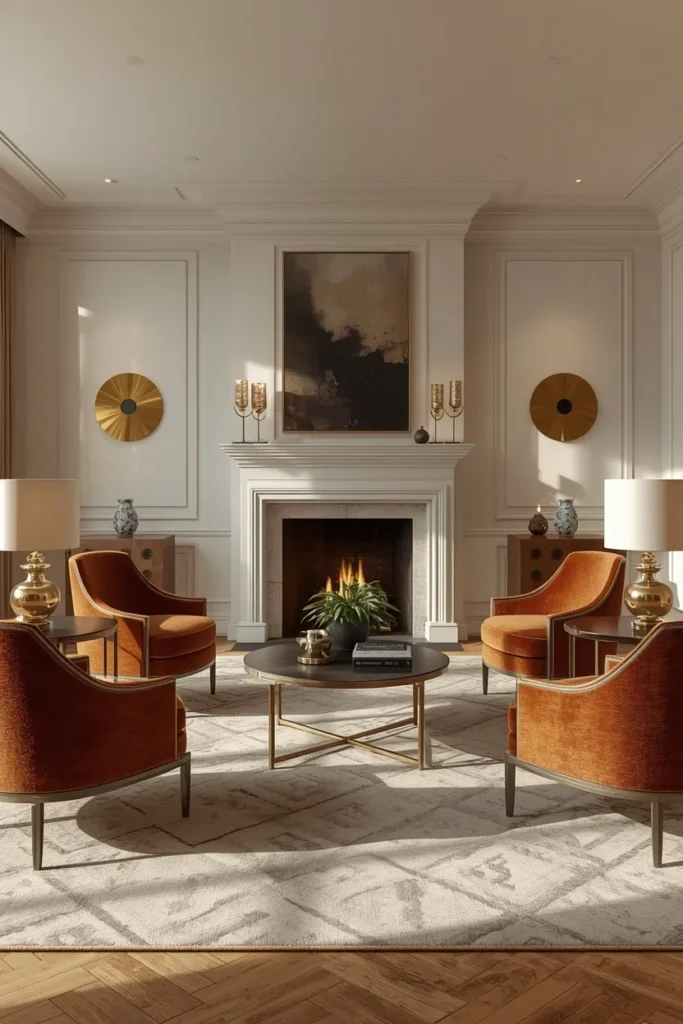
Arrange the room’s furniture in balanced, mirrored pairs, matching chairs, lamps, or side tables placed symmetrically around a central focal point like a fireplace, media wall, or piece of statement art. Symmetry is one of the quieter but most foundational principles of Neo Deco design, since a balanced layout creates an immediate sense of order and intention even before any bold color or pattern gets added. Start by identifying the room’s natural focal point, then work outward from there, placing matching furniture pieces at equal distances on either side rather than arranging everything asymmetrically around the room’s perimeter. This approach also improves the room’s actual flow and functionality, since a symmetrical layout tends to create clearer, more comfortable pathways for movement compared to a more scattered arrangement. This idea works as a foundational planning step for a full Neo Deco room, since getting the layout’s symmetry right first makes every other idea on this list, from lighting to accent chairs, noticeably easier to place well.
Styling Tips
- Choose one curved statement piece, like a sofa or an arched detail, and pair it with at least one angular or geometric piece nearby to create the visual tension that defines the Neo Deco look.
- Pick one dominant metal finish, brass, gold, or chrome, and introduce any additional metals only through smaller accent pieces rather than mixing them in equal amounts.
- Layer lighting across at least two or three heights, overhead, wall-mounted, and floor or table level, rather than relying on a single overhead fixture.
- Use jewel tones and bold color in one or two concentrated places, like a feature wall or a sofa, rather than spreading saturated color evenly across every surface.
- Keep styled surfaces, like coffee tables and consoles, relatively minimal so sculptural furniture and architectural details stay the visual focus rather than getting buried under decor.
Practical Implementation Ideas
- Start with one focal room or even one wall before expanding the style throughout the home, since testing Neo Deco at a smaller scale first helps confirm the look feels intentional rather than overwhelming.
- Choose paint and hardware finishes before large furniture purchases, since it’s easier to select a sofa or chair to match an established color and metal palette than the reverse.
- Consult a local interior designer or stylist if you’re unsure where to start, especially for structural updates like stepped molding or an arched doorway, since these benefit from professional planning.
- Visit design showrooms or browse vintage marketplaces like Chairish or 1stDibs to identify original Art Deco pieces or well-made reproductions before committing to a full room plan.
- Photograph the room in both daylight and evening lighting once a few pieces are in place, since jewel tones and metallics can look noticeably different depending on the light source.
Common Mistakes to Avoid
- Mixing too many metal finishes in equal proportion, which can make the room feel busy rather than richly layered.
- Choosing furniture that’s either entirely curved or entirely angular, which removes the visual tension that gives Neo Deco rooms their dynamic quality.
- Painting an entire room in one saturated jewel tone, which can quickly feel heavy rather than glamorous compared to using bold color in one or two concentrated spots.
- Relying on a single overhead light fixture, which leaves the room’s mood flat and underlit once natural daylight fades.
- Overcrowding styled surfaces with too many decorative objects, which buries sculptural furniture and architectural details instead of letting them stand out.
Small-Space Alternatives
For a smaller living room, a glass and brass bar cart (Idea 16) or a marble plinth with a single sculptural object (Idea 14) can introduce real Neo Deco character without requiring the floor space of a full accent wall or oversized furniture piece. A sunburst mirror (Idea 15) does double duty in a small room, adding style while also making the space feel brighter and larger through reflected light. Choosing one well-placed curved chair (Idea 3 or 18) rather than a full curved sofa can also deliver the style’s signature softness in a much smaller footprint.
Budget-Friendly Alternatives
A single jewel-toned feature wall (Idea 12) is one of the lowest-cost, highest-impact updates on this list, requiring only quality paint and a weekend of work. Peel-and-stick fluted paneling (Idea 17) delivers a similar architectural effect to built-in millwork at a fraction of the cost and without any permanent installation. Sourcing a rattan accent chair or a small sunburst mirror secondhand, rather than buying new, can also bring in genuine Neo Deco character without the cost of custom or designer furniture pieces.
Pro Styling Recommendations
Start with the room’s layout and symmetry (Idea 19) before adding any bold color or standout furniture, since a well-planned, balanced arrangement makes every subsequent styling decision easier and more cohesive. Choose one dominant metal and one dominant jewel tone early on, and hold every additional purchase up against that established palette rather than adding pieces that simply catch your eye individually. Plan lighting in layers from the very beginning of the project, since retrofitting proper ambient and accent lighting into a finished room is far more disruptive than accounting for it in the initial plan. Finally, resist the urge to fill every surface and wall with a Neo Deco detail, since the negative space between statement pieces is often what keeps the style feeling curated and modern rather than like an overwhelming period reproduction.
FAQs
Conclusion
Neo Deco works because it borrows the parts of Art Deco that still feel genuinely exciting, the geometry, the warm metal, the confident color, and leaves behind the parts that feel more like a museum exhibit than a living room. A curved sofa here, a fluted panel there, one jewel-toned wall and a sunburst mirror doing double duty as light and art. None of it requires committing to every idea at once. Pick a focal point, choose one dominant metal and one bold color, and build outward from there, layering in lighting and texture as you go. The room doesn’t need every detail on this list. It needs enough of them, placed with intention, to feel like glamour that was actually meant to be lived in.