17 Effortless Vintage Christmas Decor Ideas for a Nostalgic Home Straight Out of a Magazine
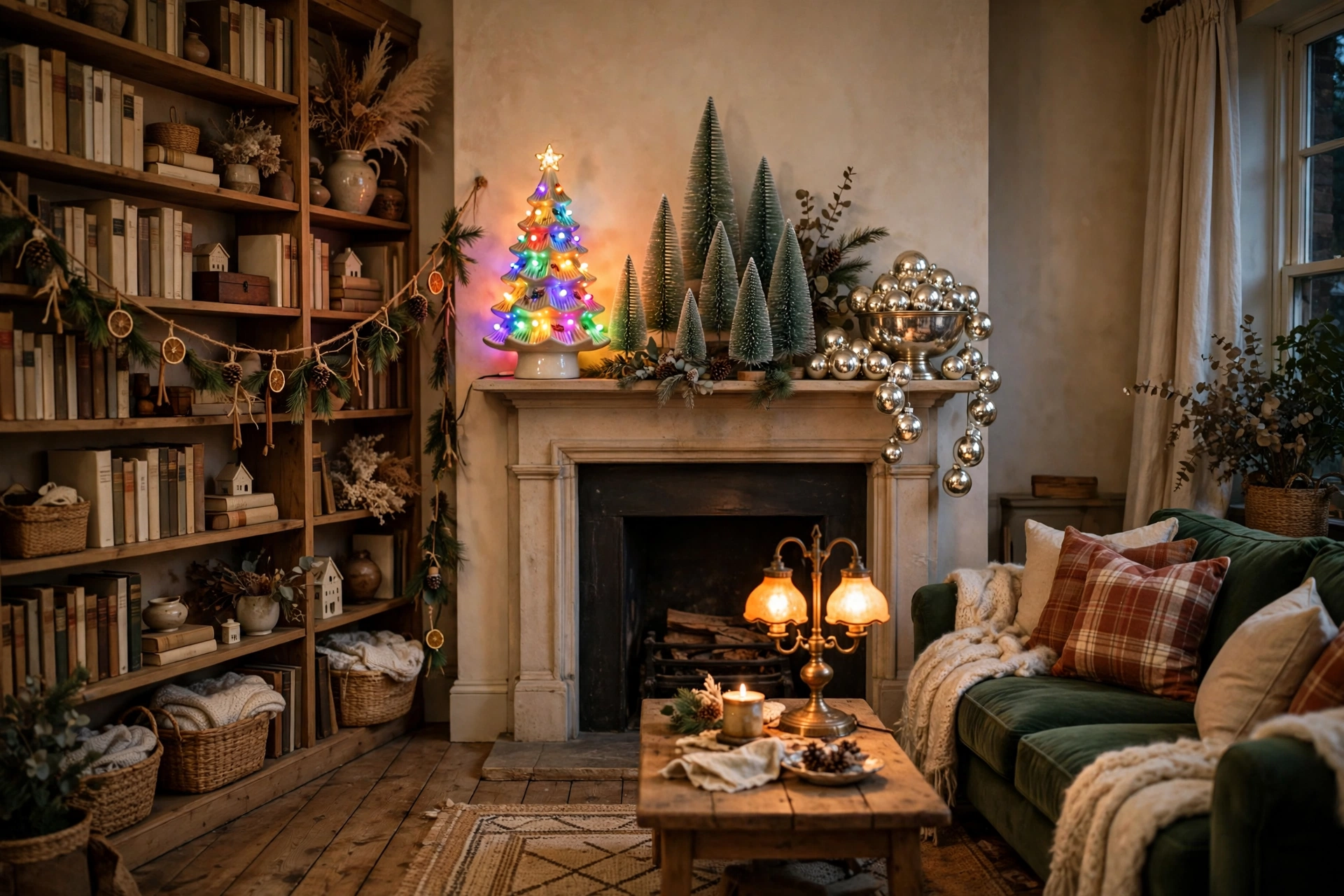
There’s a particular kind of Christmas nostalgia that no new product, however well-designed, quite manages to replicate — the exact color of a mercury glass ornament that’s spent sixty winters in someone’s attic, the specific hum of a bubble light warming up, the smell of an old cardboard ornament box. A truly vintage Christmas isn’t really about buying “vintage-style” items off a retail shelf; it’s about sourcing pieces with real history, understanding which decade’s look you’re actually going for, and knowing how to display fragile, decades-old decorations safely. These 17 ideas cover the classic bottle brush trees and mercury glass every vintage Christmas list mentions, along with the era guide, thrifting advice, and electrical safety information that most vintage decor roundups skip entirely.
Table of Contents
Why Vintage Christmas Decor Feels Different From “Vintage-Style”
A lot of what gets marketed as “vintage Christmas decor” is actually new production made to look old, which is a perfectly valid style choice but a genuinely different project from decorating with real vintage or antique pieces. Reproductions are safer, more consistent in quality, and easier to buy in matching sets, while the genuine article carries small imperfections, mismatched patinas, and a one-of-a-kind history that no two shoppers can replicate exactly. The most convincing vintage Christmas rooms usually blend both: a few real thrifted or inherited pieces as the emotional anchor, filled out with newer reproductions for the items that need to actually function, like lights and tree stands. Knowing which category a piece falls into also matters for safety and care, since a real 1960s light strand needs to be handled very differently than a brand-new one designed to look like it.
17 Effortless Vintage Christmas Decor Ideas
Set Up a Ceramic Light-Up Christmas Tree
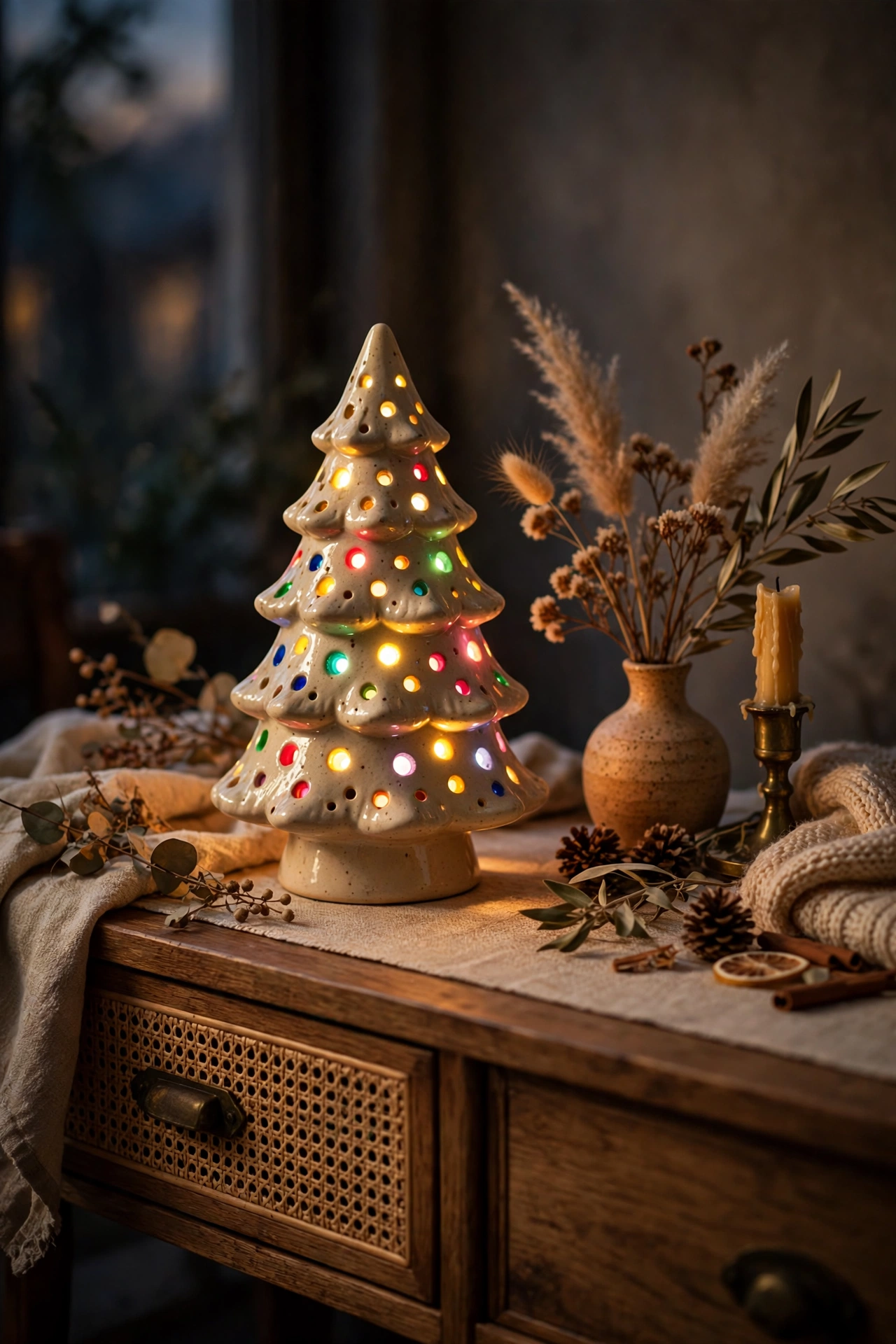
A small ceramic tree with a built-in bulb that glows through drilled “lights” in a rainbow of colors was once a fixture on nearly every grandparent’s console table, and it remains one of the most instantly nostalgic pieces a vintage Christmas display can include. Genuine vintage versions turn up regularly at estate sales and antique malls, often for less than a new reproduction, though checking the base for a working, intact cord and plug matters before buying an electrical piece secondhand. Placing it somewhere it can glow after dark without much other competing light lets the specific warm, multicolored effect really read the way it did decades ago. A tree missing a few of its plastic “light” pegs isn’t a dealbreaker, since replacement pegs are inexpensive and widely available online in the original colors. This single piece does an outsized amount of nostalgic work for its small footprint, making it one of the best entry points for anyone just starting a vintage Christmas collection.
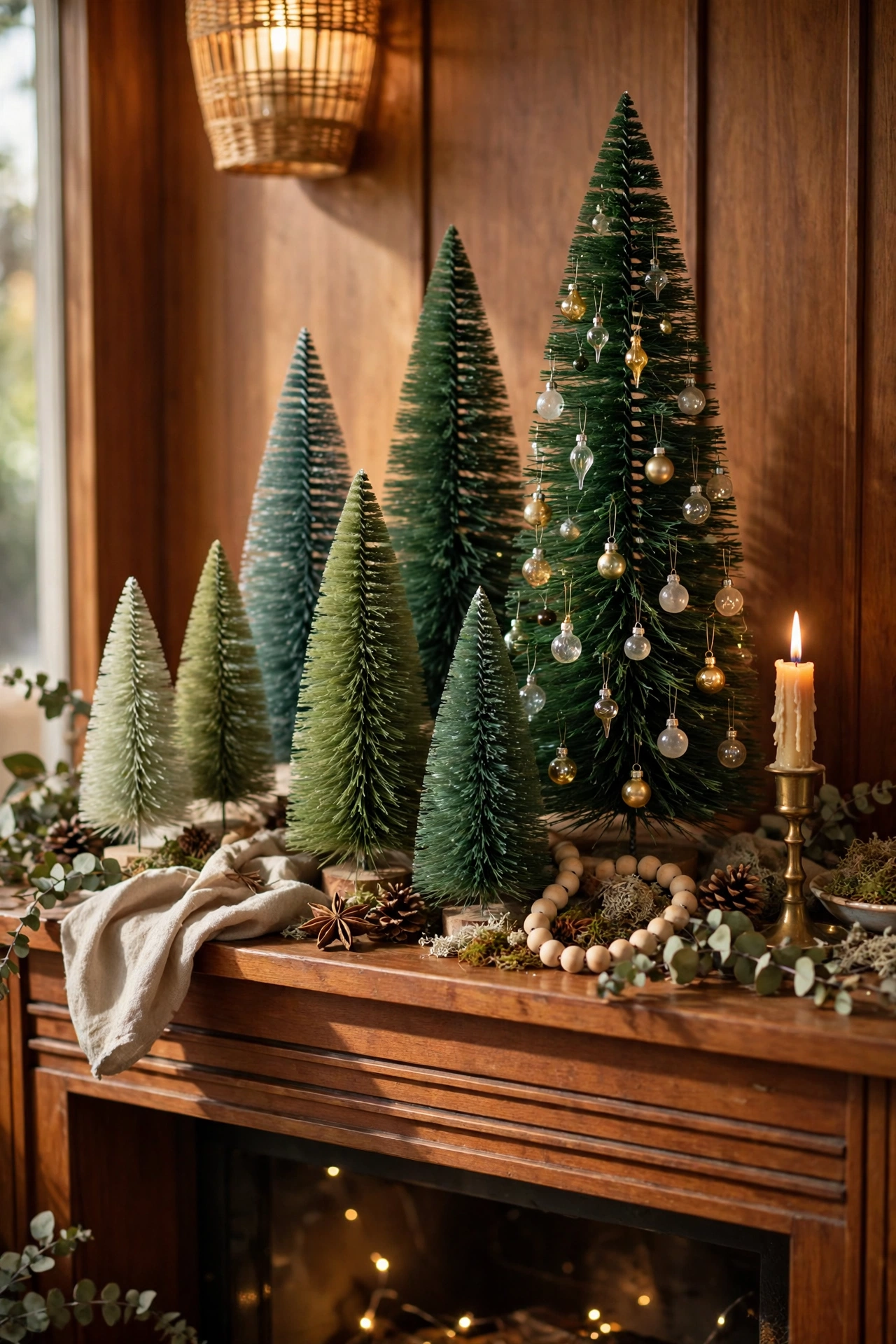
Cluster Bottle Brush Trees in Varying Heights
Bottle brush trees, made from dyed bristle wrapped around a wire frame, were a mid-century Christmas staple long before they became a favorite of modern farmhouse and vintage stylists alike. Grouping several at different heights on a mantel, shelf, or windowsill creates a small forest effect that reads as far more elaborate than the individual cost of each tree suggests. Mixing a few genuinely vintage trees, often found at estate sales with a slightly faded or unevenly dyed bristle, alongside new reproductions blends real character with reliable structure. Adding tiny vintage-style glass ornaments or a dusting of fine glitter to just the largest tree in the cluster gives the group a focal point without overdoing every piece. Because they’re lightweight and take up very little storage space, bottle brush trees are also one of the easiest vintage collections to build gradually, one thrift store trip at a time.
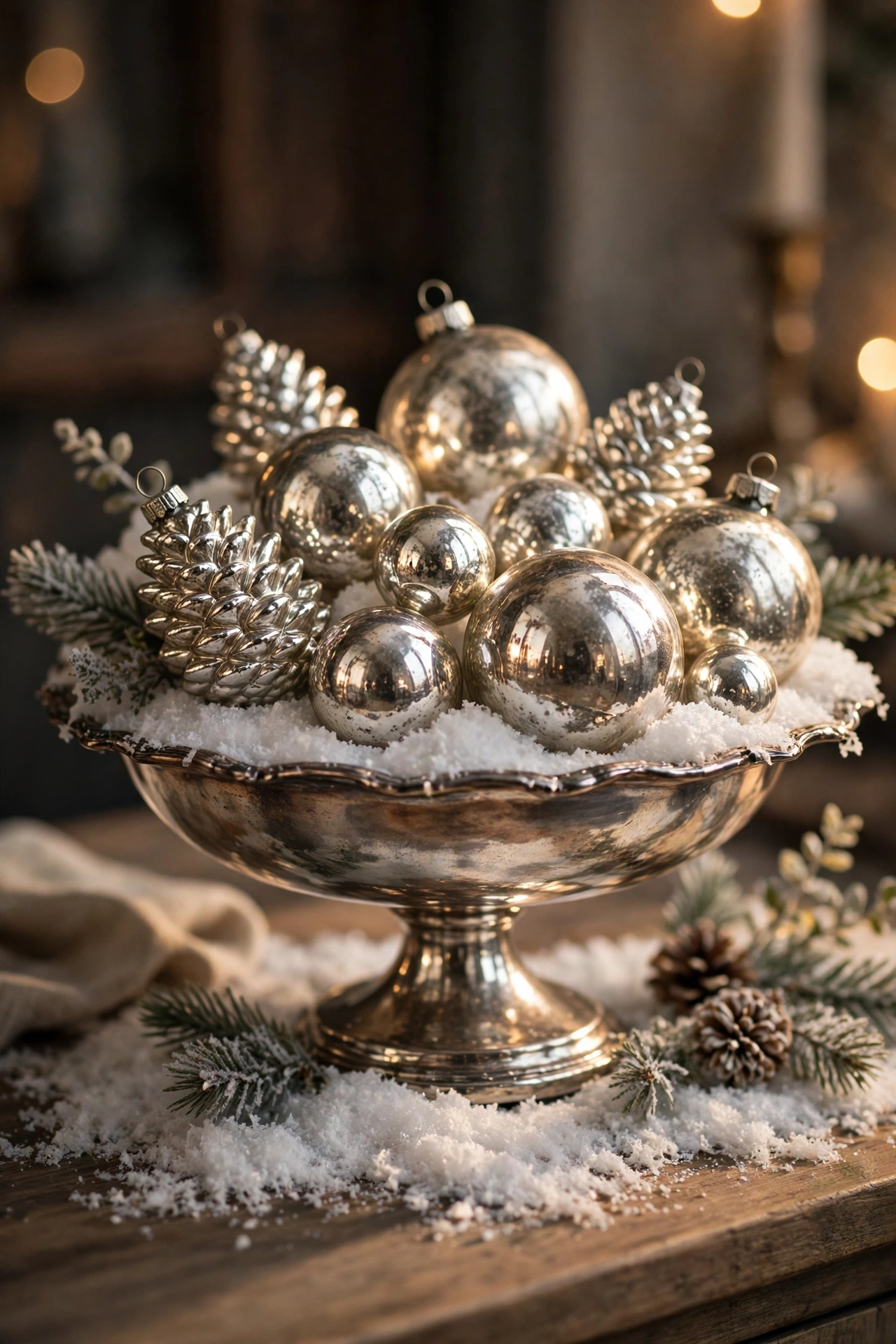
Fill a Bowl With Mercury Glass Ornaments
Mercury glass ornaments, with their distinctive silvered interior and slightly imperfect, hand-blown shapes, catch light in a way that modern shatterproof plastic ornaments simply can’t replicate. Piling a mix of round and pinecone-shaped mercury glass into a large glass bowl or vintage silver compote makes an easy centerpiece for a table, sideboard, or mantel that requires no hanging or wiring at all. True antique mercury glass is genuinely fragile and often shows small chips or worn silvering, which collectors consider part of the charm rather than a flaw to hide. Layering the bowl over a bed of faux snow or greenery softens the edges of the display and keeps the ornaments from rolling if the bowl gets bumped. Because mercury glass ornaments are lightweight and don’t require any electrical component, this is one of the safest and simplest genuinely-antique pieces to build a whole vintage collection around.
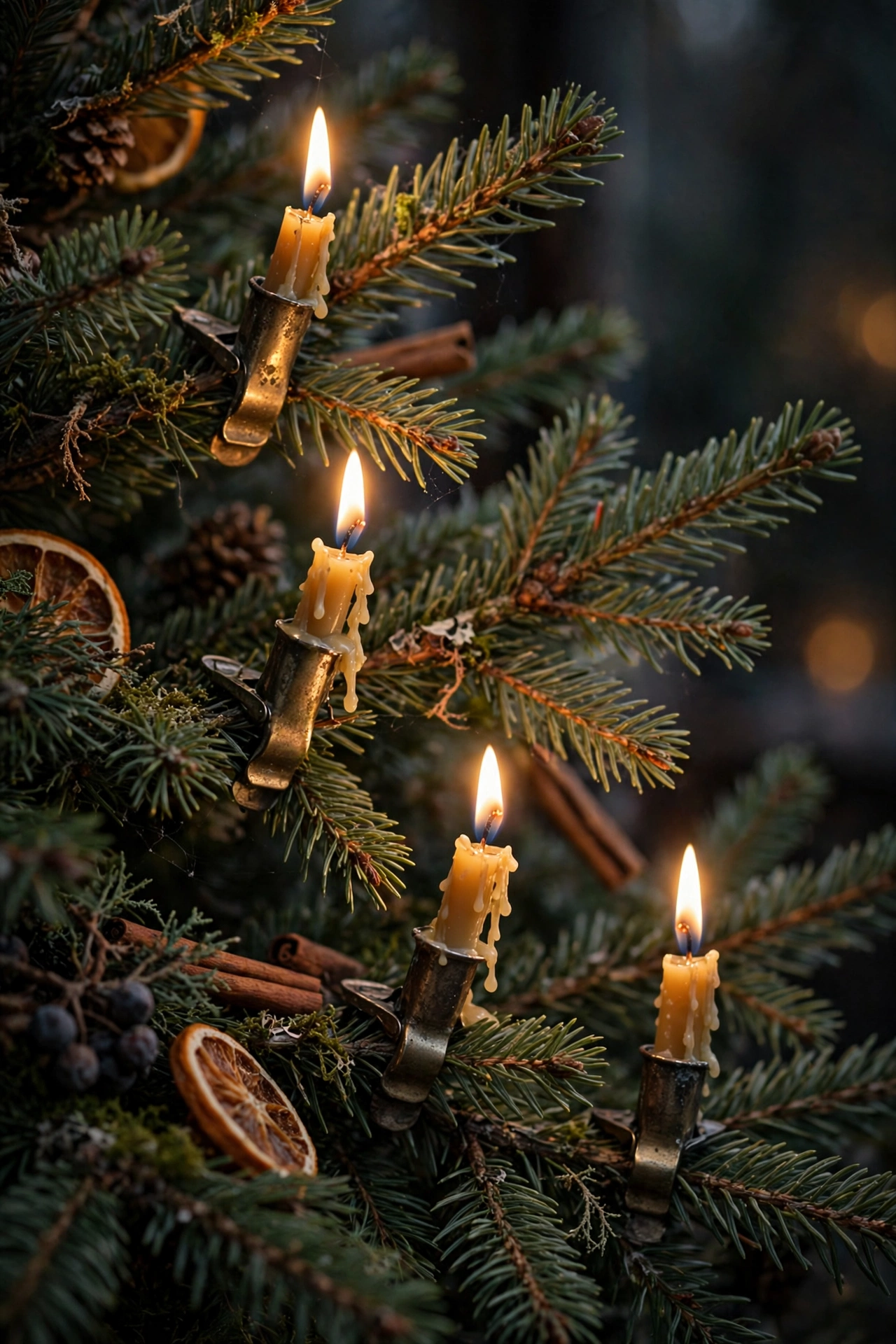
Add Vintage Clip-On Candle Tree Lights
Before string lights became standard, small clip-on candle holders held real (or later, electric) tapers directly onto tree branches, and the look remains one of the most distinctly old-world Christmas tree styles available. Modern battery-operated versions replicate the flickering warmth of the original electric clips without any of the fire risk tied to genuinely old wiring or real open flames on a tree. Clipping them at slightly uneven heights and angles across the tree, rather than in a perfectly even grid, mimics how they were traditionally placed by hand rather than machine-strung. This look pairs especially well with a Victorian or European-inspired vintage theme, since candle-lit trees predate the electric light strand by decades. If using genuinely antique electric clip candles rather than new battery versions, testing each one individually before trusting it on a tree overnight is a safety step worth taking seriously.
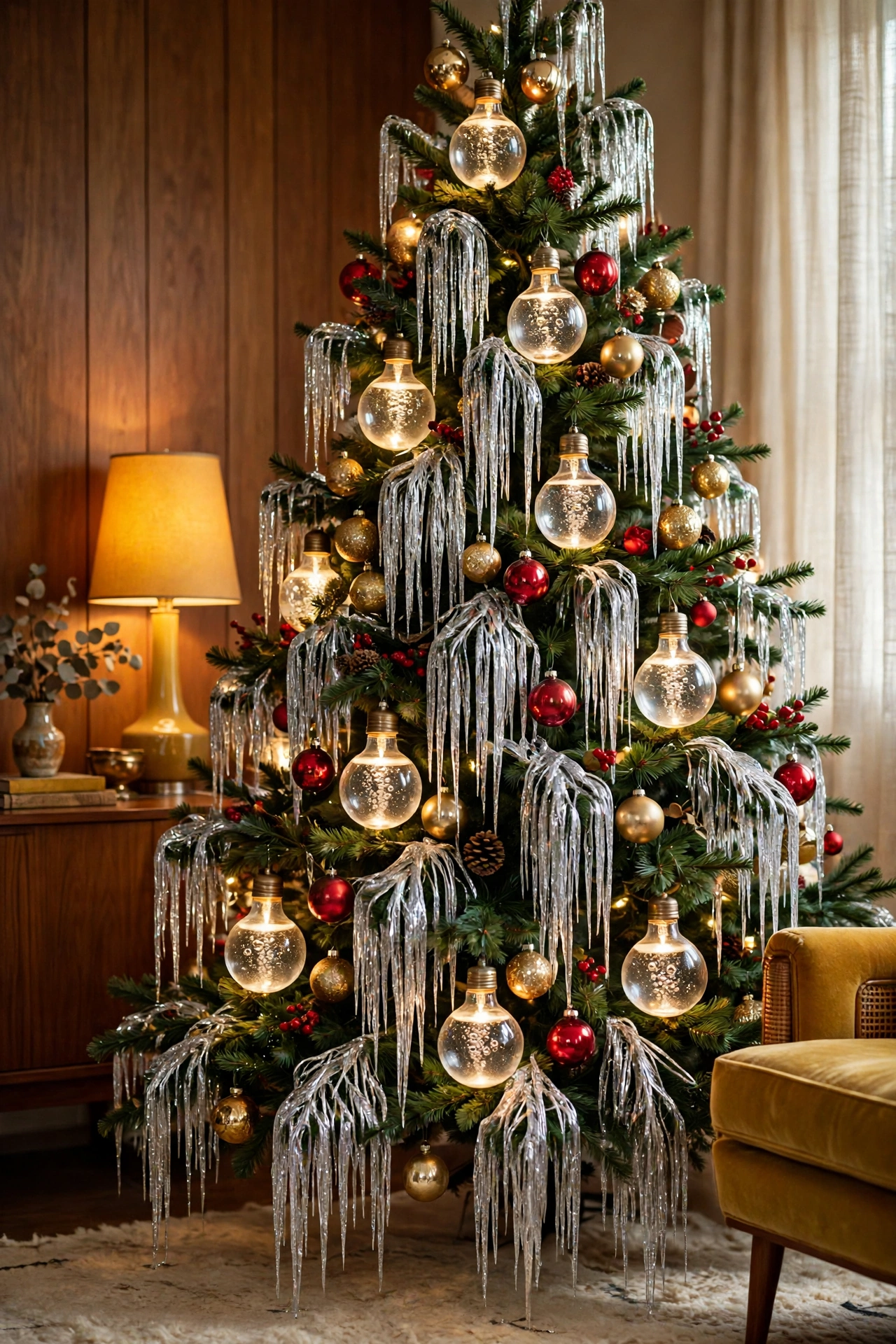
Style a Tinsel and Bubble Light Tree
A tree draped in silver tinsel icicles and strung with bubble lights, the vintage strand that uses heated liquid to create a rising bubble effect inside each glass bulb, is one of the most recognizable mid-century Christmas looks and remains widely reproduced today in safer, modern wiring. Layering tinsel strand by strand, rather than tossing it on in clumps, is more time-consuming but produces the shimmering, cascading effect associated with 1950s and 1960s trees. New reproduction bubble lights use updated, safer wiring while preserving the same glowing, bubbling effect as the originals, making them the safer choice for most households over genuinely vintage strands. Pairing this style with ornaments in classic red, green, and gold, rather than pastel or modern metallics, keeps the whole tree consistent with its retro inspiration. This is one of the more labor-intensive ideas on the list, but it’s also one of the most photographed vintage tree styles on Pinterest for exactly that reason.
Related: 25 Modern Ways to Decorate a Small Living Room for Christmas
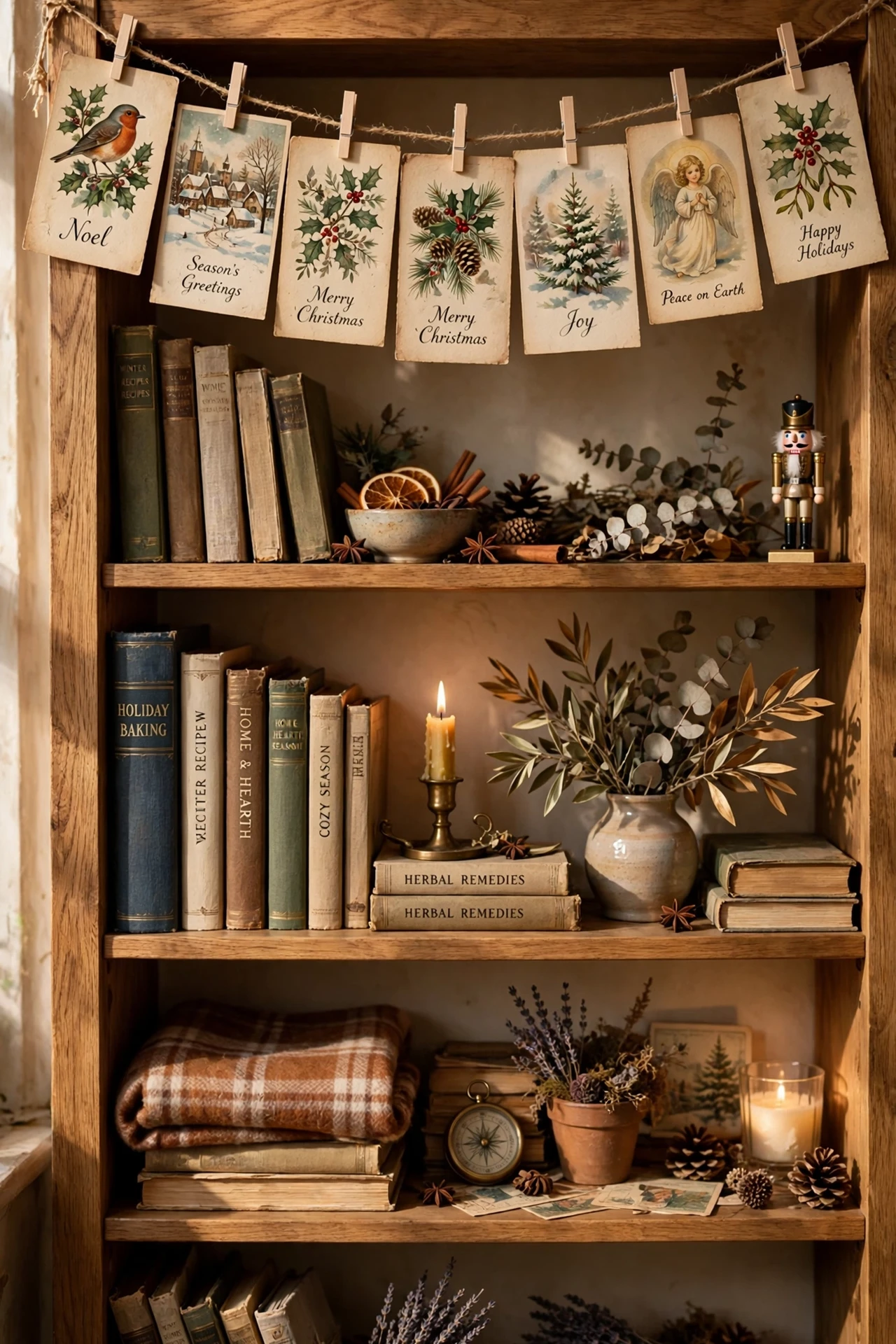
Make a Vintage Christmas Card Garland
Stringing a collection of vintage or reproduction Christmas cards along a length of ribbon or twine, then draping the garland across a bookshelf, staircase, or mantel, turns old holiday correspondence into a genuinely personal decoration. Real vintage cards, often available in bulk lots at antique malls or estate sales for very little per card, tend to feature the mid-century illustration style — sleigh scenes, cardinals, snow-dusted cottages — that defines a lot of nostalgic Christmas imagery. Attaching each card with a small binder clip or clothespin rather than glue keeps the garland fully reversible and protects the cards themselves from damage. Mixing in a few family members’ actual holiday cards from years past adds a personal layer that a purely thrifted garland doesn’t have on its own. This is one of the most affordable ideas on the entire list, since a large lot of vintage cards typically costs less than a single new decorative garland from a retail store.
String a Popcorn and Cranberry Garland
A garland of popped popcorn and fresh cranberries, strung by hand with a needle and heavy thread, predates electric lights as a Christmas tree decoration and remains one of the most authentically old-fashioned projects on this entire list. Working with slightly stale, day-old popcorn threads more easily and holds together better than fresh popcorn, which tends to crumble under the needle. Alternating a few cranberries between every three or four popcorn pieces adds a pop of red color without needing so many cranberries that the garland becomes heavy or prone to breaking. Because both materials are perishable, this garland is best made close to when it will be displayed and treated as a short-term seasonal project rather than something to store and reuse. This idea is also a genuinely good hands-on activity for a family gathering, since the process itself carries as much nostalgic value as the finished garland.

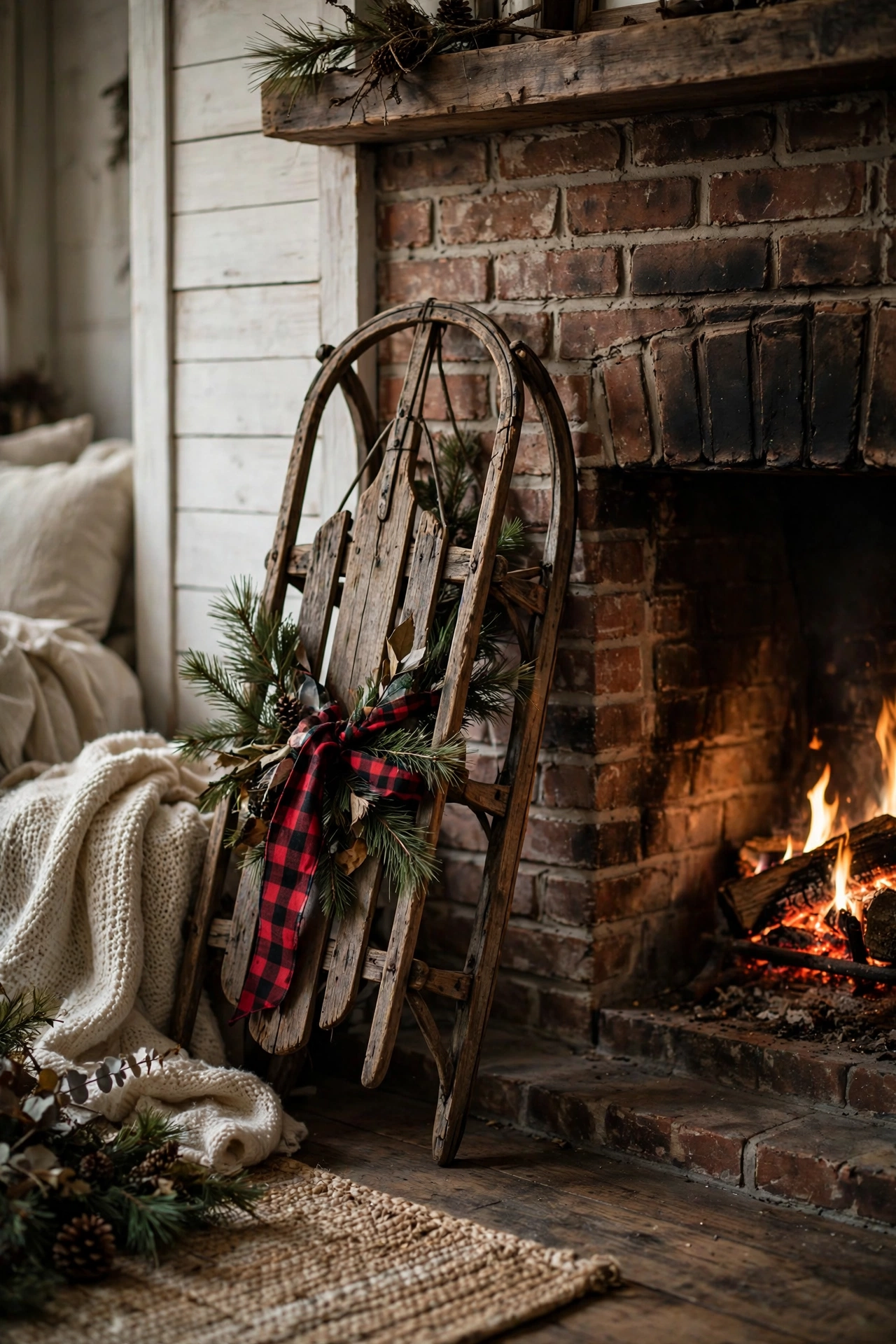
Style an Antique Sled or Ice Skates as a Mantel Prop
A weathered wooden sled or a pair of leather-strapped antique ice skates, leaned against a mantel or propped in a corner, brings in a large-scale vintage accent that doesn’t require any electrical safety consideration at all. Tucking a small bundle of greenery, a plaid ribbon, or a few pinecones into the curve of the sled’s runners softens the display and ties it into the rest of the room’s seasonal color palette. These pieces are commonly found at antique malls, flea markets, and estate sales, often at a range of price points depending on condition and any visible maker’s marks or brand names. Rust, chipped paint, and worn leather straps are generally considered part of the appeal rather than flaws to restore, since an overly polished antique can end up looking more like a new reproduction. This is one of the strongest focal-point pieces on the list for anyone building a room around a specific nostalgic scene rather than smaller scattered accents.
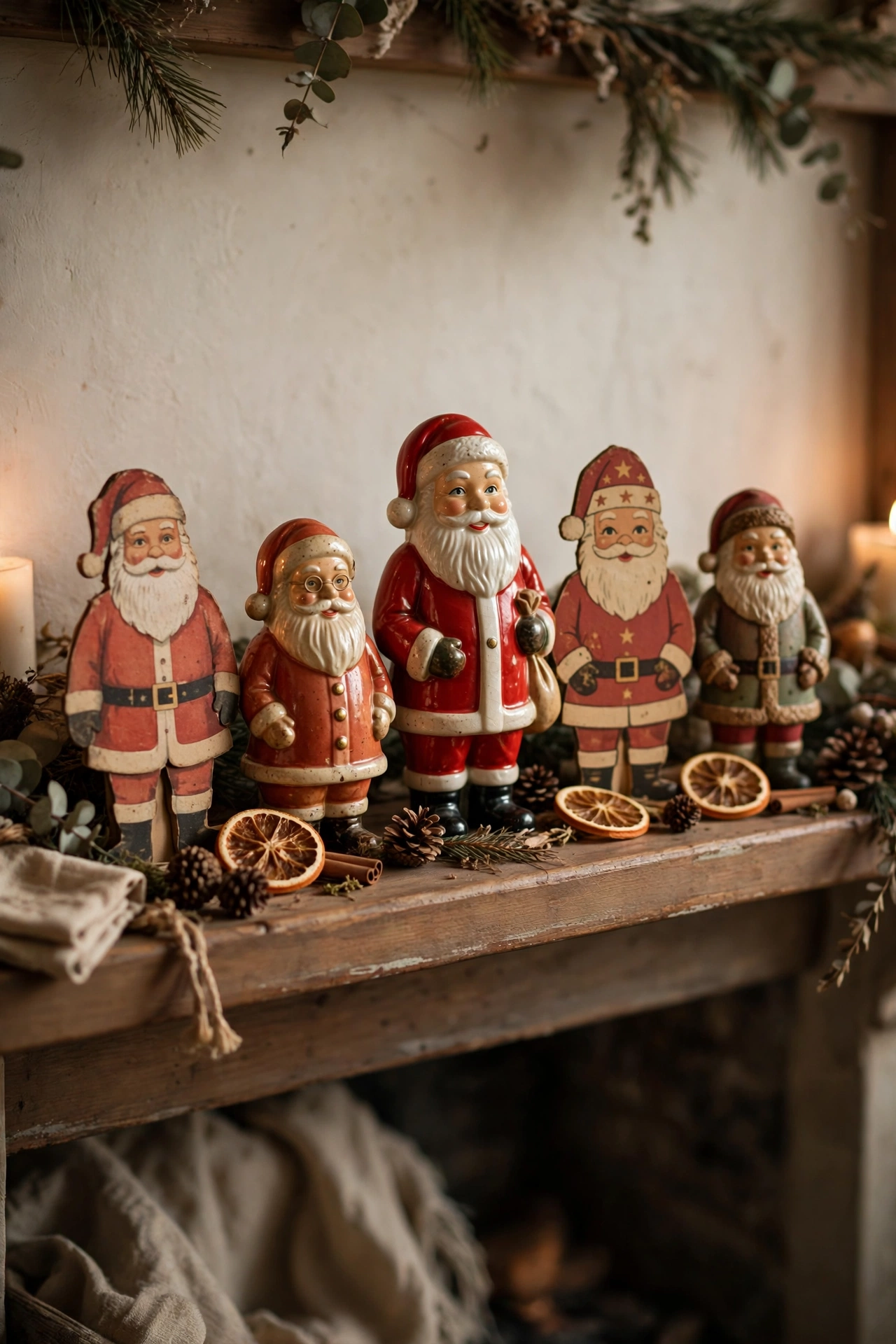
Display a Collection of Vintage Santa Figurines
A grouping of vintage Santa figurines, whether ceramic, cardboard, or celluloid, arranged along a mantel or shelf brings together decades of Christmas decorating history in one small collection, since Santa’s depicted appearance has shifted noticeably across eras. Grouping figurines by rough size or era, rather than mixing every style randomly, gives the display a more curated, museum-shelf feeling. Because celluloid and early plastic figurines can be genuinely fragile and occasionally brittle with age, handling them minimally once placed and keeping them out of direct sunlight helps prevent further deterioration. Estate sales and dedicated vintage Christmas dealers are typically the most reliable sources for these figurines, since general thrift stores see less consistent stock of them compared to more common items like ornaments. This collection-based idea works well as a slow-build project, since figurines can be added one or two at a time across several holiday seasons without needing to complete the whole set at once.
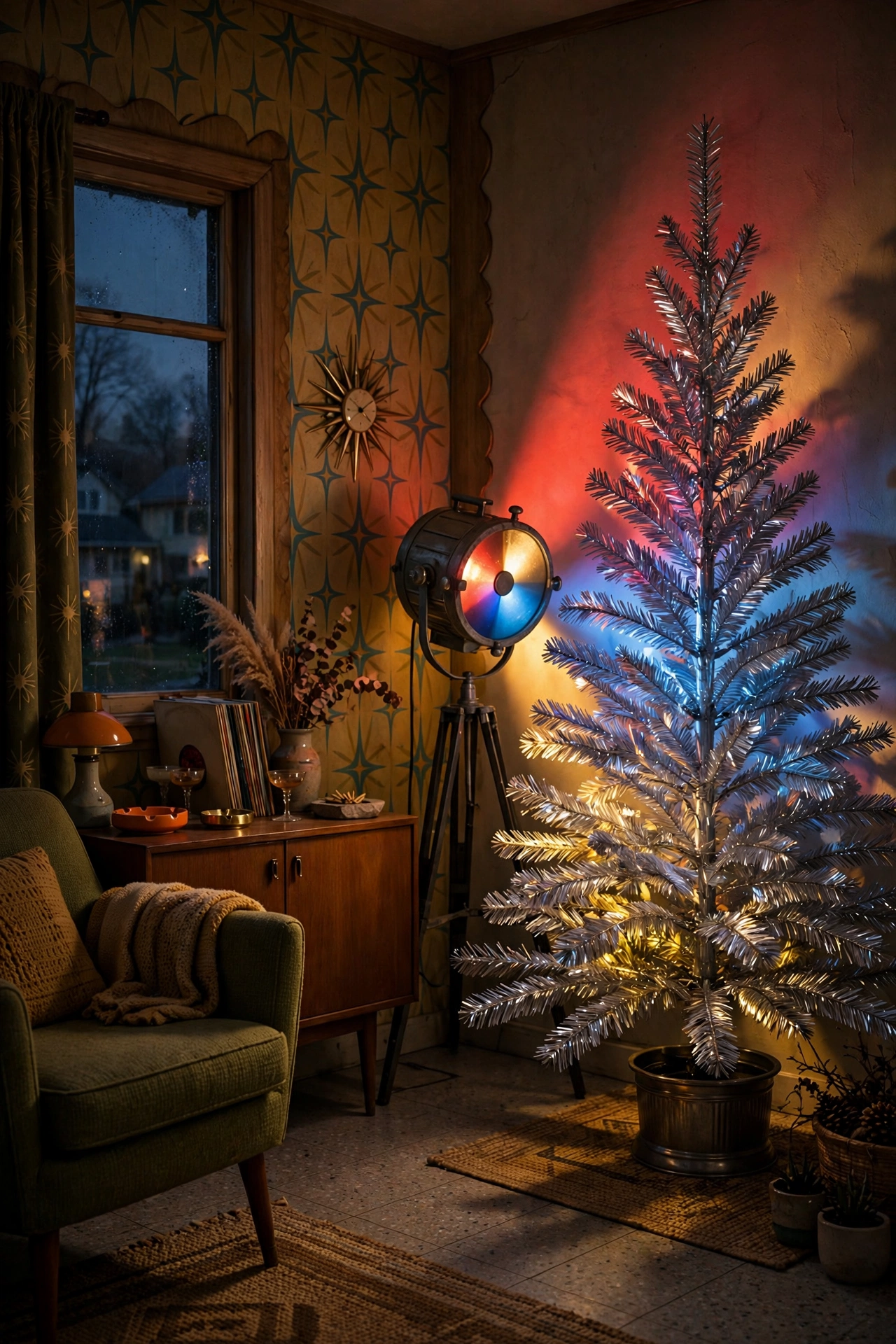
Bring Back a Retro Aluminum Tree With a Color Wheel
An aluminum Christmas tree, paired with a rotating color wheel spotlight that cycles through red, blue, green, and gold, is one of the most distinctly 1960s Christmas looks and remains instantly recognizable to anyone who grew up with or has seen “A Charlie Brown Christmas.” Because aluminum trees have no ornaments or lights of their own — the color wheel does all the visual work — the tree itself should stay minimally decorated, if at all, to preserve the intended effect. Genuine vintage aluminum trees can be pricier collector’s items depending on branch count and condition, while faithful reproductions offer a nearly identical look at a fraction of the cost. Positioning the color wheel a few feet from the tree, rather than directly against it, prevents the light from concentrating too intensely on one section of branches. This is one of the more distinctive, conversation-starting ideas on the entire list, since it looks unlike almost any other Christmas tree style in common current use.
Hang Personalized Needlepoint Stockings
Needlepoint stockings, often featuring a Santa, nutcracker, or bear motif with a hand-embroidered name across the cuff, carry a specific nostalgic weight for anyone who grew up with one hanging on their own childhood mantel. Genuine vintage needlepoint stockings occasionally turn up at estate sales, though many people choose new versions made in the same traditional style and have them personalized to start a fresh tradition. Hanging a full set together along a mantel or staircase railing, rather than spacing them far apart, creates the classic full-family lineup look associated with this specific style. Choosing a classic serif or script font for personalization, rather than a modern sans-serif, keeps the finished stocking feeling period-appropriate rather than contemporary. This is one of the most sentimental ideas on the list, since it’s specifically designed to be added to and passed down over years rather than restyled each season.

Set a Table With Lace and Embroidered Linens
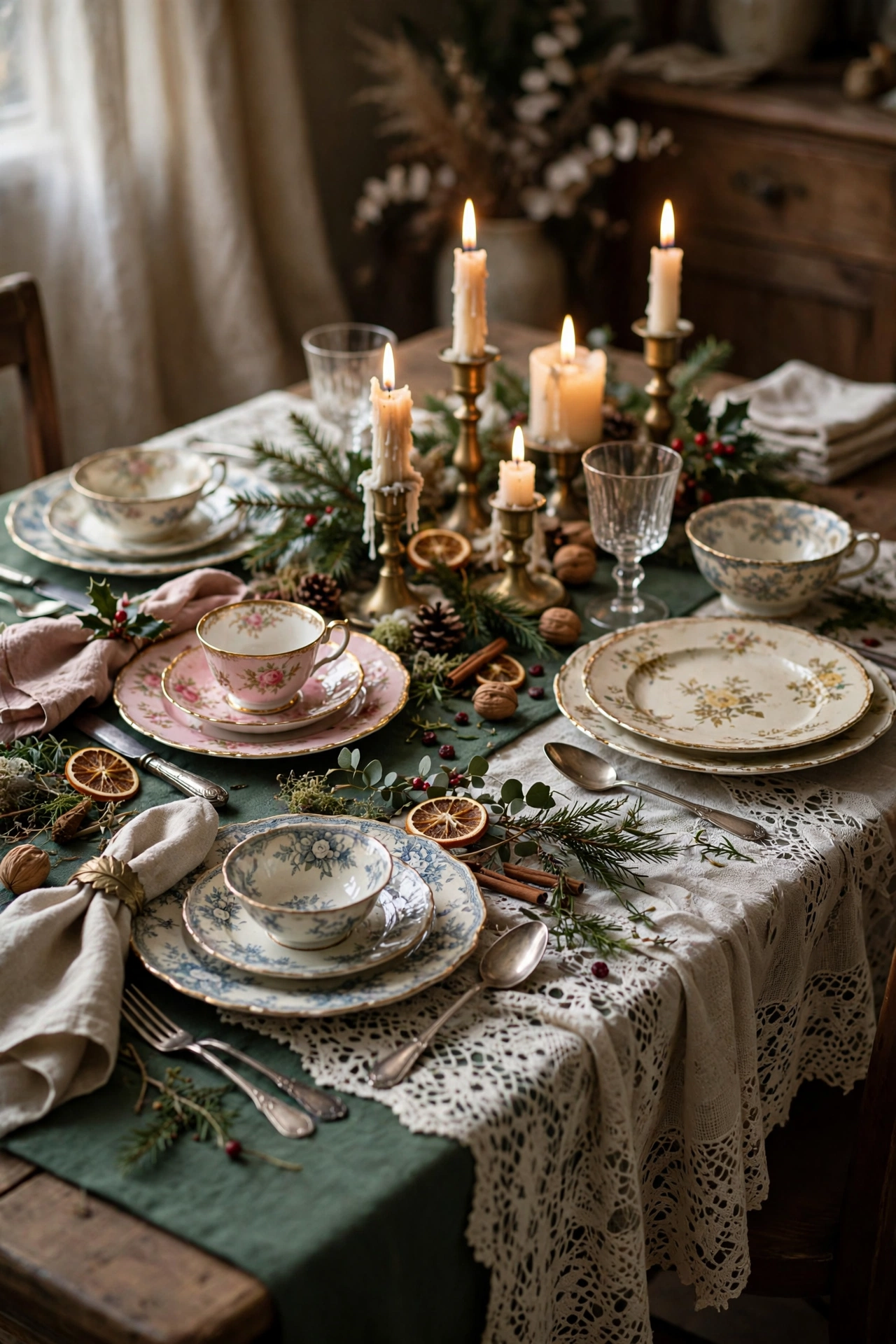
A vintage lace tablecloth or an embroidered linen runner, often sourced from an estate sale or inherited directly from a family member, brings a Victorian-inspired softness to a Christmas table that new linens rarely replicate at the same price point. Layering a smaller lace runner over a solid-colored tablecloth, rather than using lace as the sole covering, adds texture while protecting the more delicate piece from spills and heavy dishware. Vintage linens sometimes carry small yellowing or thin spots with age, which can often be improved with a gentle hand-wash but should be expected as part of buying genuinely old textiles. Pairing the linens with mismatched vintage china, rather than a single matched set, reinforces the collected-over-generations feeling that defines this particular vintage style. This idea works especially well as the base layer for a full vintage tablescape, since nearly every other tabletop idea on this list can be layered directly on top of it.
Style Thrifted Silver Trays and Pitchers as a Centerpiece
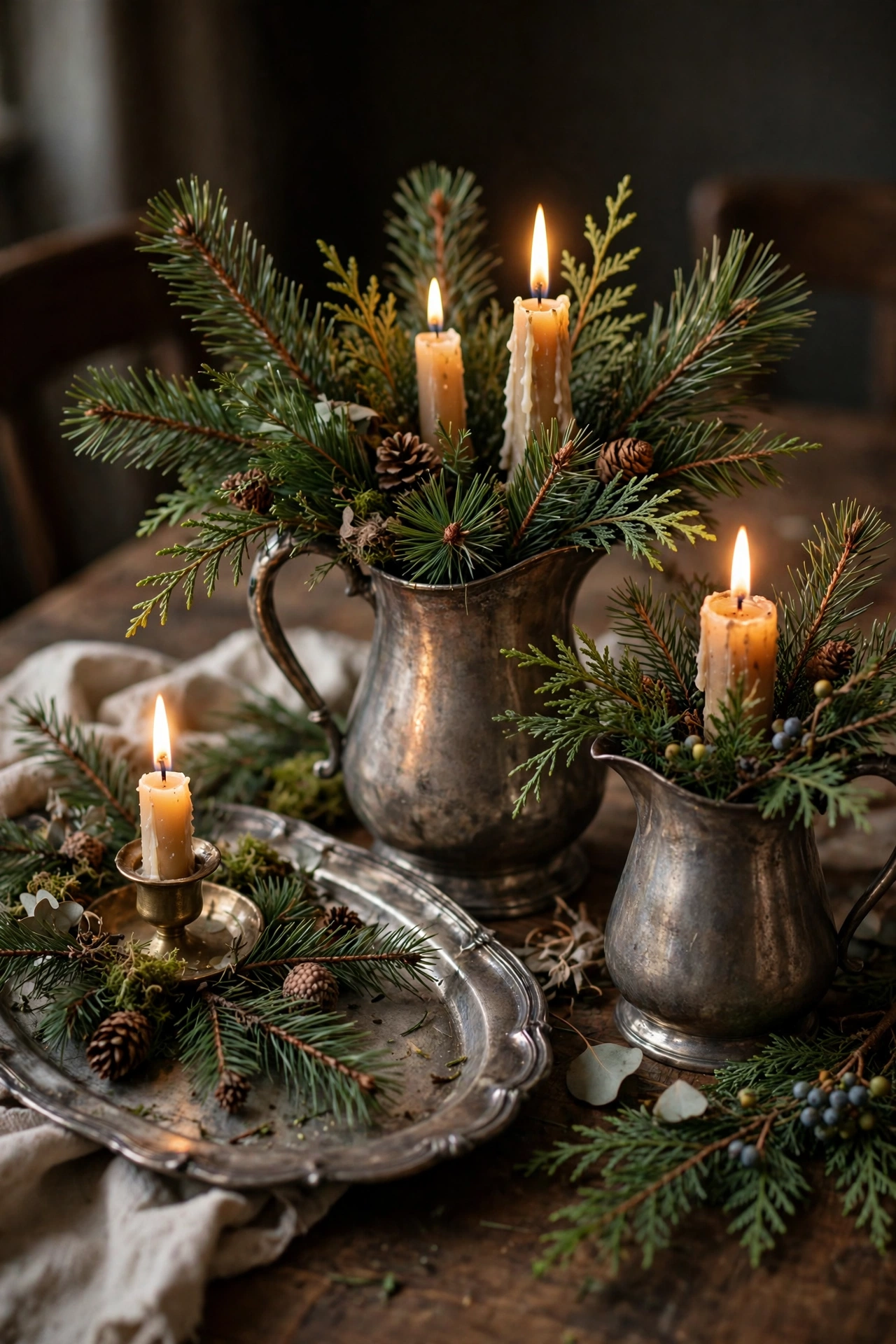
Tarnished or freshly polished silver-plate trays, pitchers, and candlesticks, commonly found at estate sales for a fraction of their original retail cost, make an elegant, reflective centerpiece base for candles, greenery, or a bowl of ornaments. Leaving a small amount of natural tarnish in the recessed details of an ornate piece, rather than polishing it to a mirror shine, is a technique many collectors and stylists use to emphasize the age and craftsmanship of the design. Grouping several mismatched silver pieces of varying heights together creates a more visually interesting cluster than a single matched silver set would. Real silver-plate items are heavier and cooler to the touch than modern silver-toned plastic or resin decor, which is one of the easiest ways to distinguish genuine vintage pieces while thrifting. This idea pairs naturally with the lace tablescape above, since both lean on the same Victorian-inspired material language of silver, lace, and candlelight.
Stack Vintage Christmas Books With Tiny Figurines
A short stack of old Christmas-themed books or classic literature, topped with a small vintage pixie, elf, or reindeer figurine perched among a dusting of faux snow, makes an easy, low-cost vignette using items that are simple to source secondhand. Turning one or two books on their side within the stack adds visual variation and gives a tiny figurine a flatter surface to stand on securely. Choosing books with worn, textured cloth covers rather than glossy modern dust jackets keeps the vignette consistent with the overall vintage material palette. This is one of the easiest ideas on the list to assemble entirely from items already owned, since most households have at least a few older hardcover books that fit the look. It also works well repeated in small versions across several shelves or side tables throughout a room, rather than existing as a single large display.

Wrap Gifts With Brown Paper, Twine, and Vintage Tags
Plain brown kraft paper, tied with cotton twine and finished with a small sprig of greenery or a reproduction vintage gift tag, gives wrapped presents under the tree a cohesive, old-fashioned look that also happens to be one of the more affordable wrapping options available. Stamping the paper with a simple potato-cut or rubber stamp design in a single ink color adds pattern without needing printed wrapping paper at all. Using genuinely old holiday stickers or gift tags, sourced from an ephemera lot at an antique mall, adds an authentic period detail that most people never think to seek out specifically for gift wrap. This idea extends the vintage theme all the way down to the base of the tree, an area many decorators otherwise leave as an afterthought once the tree itself is finished. Brown paper and twine are also fully recyclable, unlike many glossy printed wrapping papers, which is a practical bonus alongside the aesthetic one.

Build a Wreath From Mismatched Vintage Ornaments
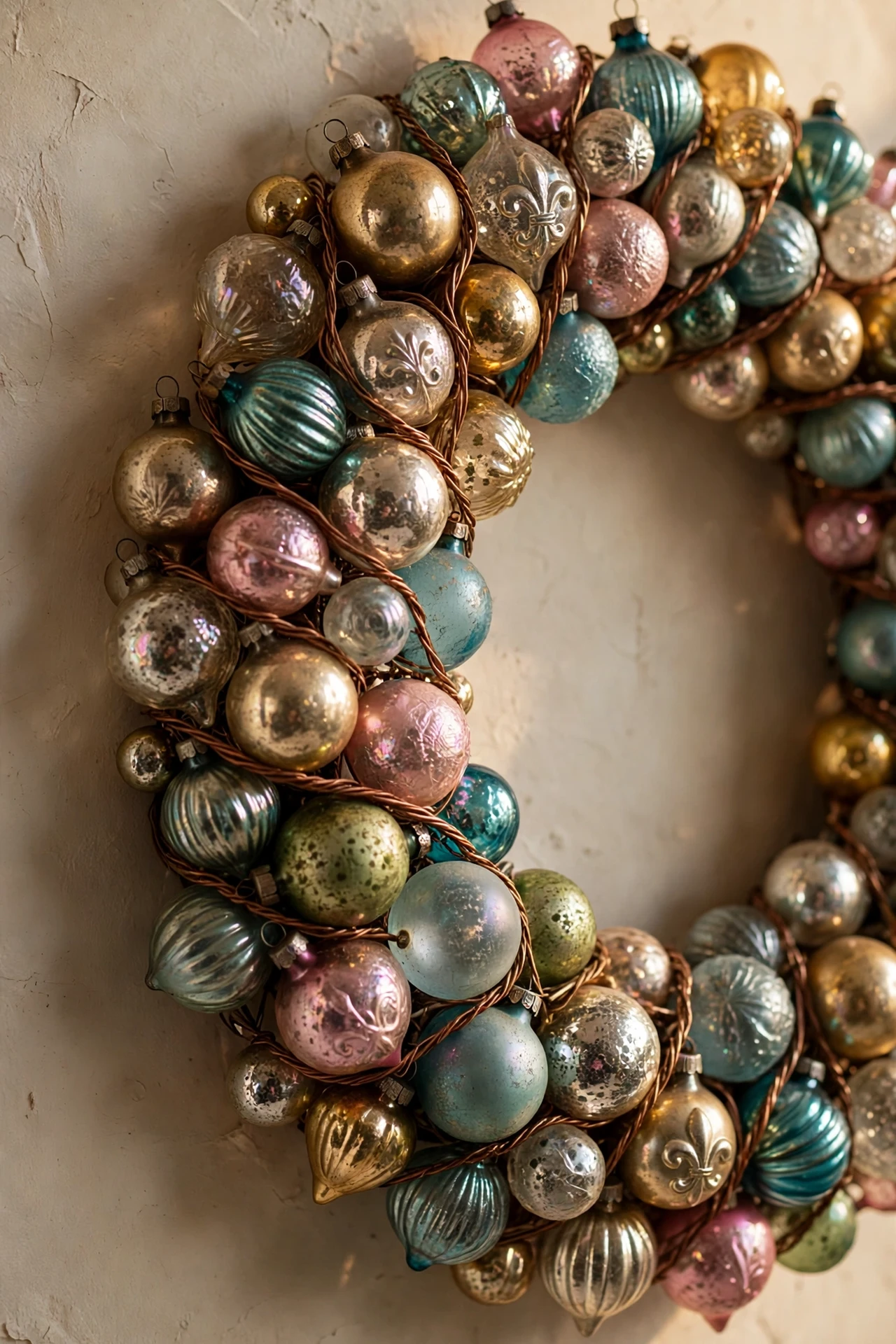
A wreath base wired with dozens of small mismatched vintage or vintage-style glass ornaments, rather than the traditional evergreen greenery, turns broken sets and orphaned single ornaments into a genuinely one-of-a-kind statement piece. Attaching each ornament with its own small loop of florist wire, working in a spiral pattern from the outer edge inward, keeps the finished density even across the whole wreath. This is an especially good project for using ornaments that are missing a partner from a set, have small chips, or were inherited in a mixed, non-matching box, since the wreath’s whole appeal comes from the variety rather than a matched look. Hanging the finished wreath somewhere protected from wind and heavy handling, like an interior wall rather than an exposed front door, protects the more fragile glass pieces from breakage. This idea turns what might otherwise be considered “leftover” decor into the most eye-catching, genuinely handmade piece in the whole house.
Set Up a Retro Record Player Christmas Corner
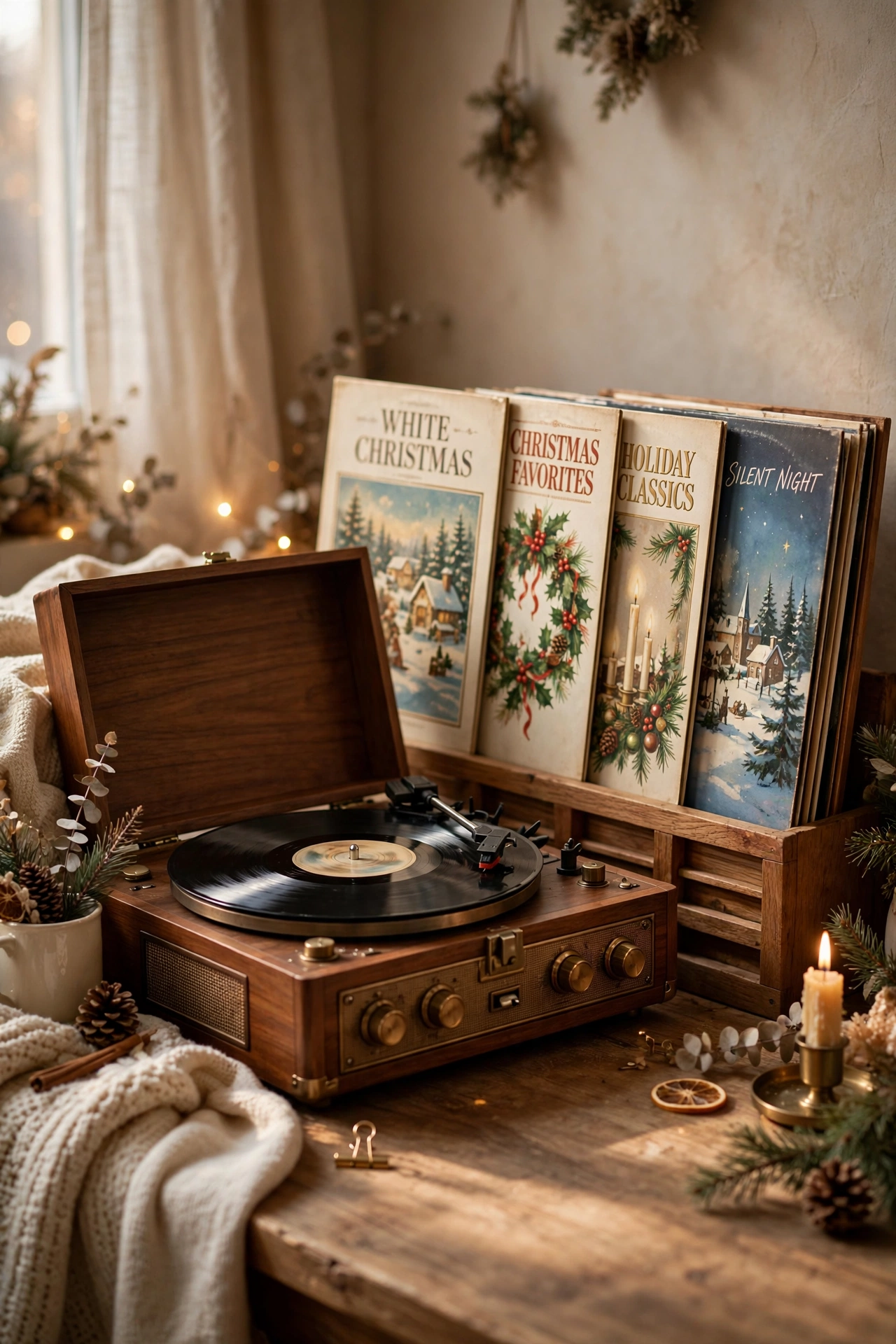
A vintage or reproduction record player, paired with a small stack of classic Christmas albums on vinyl, turns background music into a visible, styled part of the room rather than something played invisibly through a phone speaker. Displaying a few album covers upright nearby, rather than only stacked flat, adds graphic color and interest that most modern speaker setups can’t replicate visually. Placing the corner near the ceramic tree or bottle brush cluster ties the audio element into the same overall vintage visual language as the rest of the room. This idea works well even without a fully functional antique record player, since many companies now make faithfully styled reproduction turntables that play modern records with a genuinely vintage look. It’s one of the few ideas on this list that engages a sense beyond sight, which is exactly the kind of full sensory nostalgia that separates a truly convincing vintage Christmas room from one that only looks the part in photos.
Related: 23 Christmas Centerpieces for Every Style of Table For a Home That Feels Festive All Season
Styling Tips for a Cohesive Vintage Look
- Pick one dominant era (Victorian, 1950s atomic, or 1960s-70s retro) as an anchor, then let a few pieces from other decades mix in intentionally rather than evenly.
- Leave a little visible imperfection — a slightly tarnished tray, a faded bottle brush tree — since an overly polished vintage display can start to look like a new reproduction.
- Group collections (Santas, mercury glass, silver pieces) together rather than scattering them individually, which reads as more curated and intentional.
- Balance genuinely fragile antique pieces with a few sturdy reproductions so the room still feels usable and lived-in, not like a museum display.
- Let a few personal or inherited pieces anchor the room, since real sentimental history is the one thing no amount of shopping can replicate.
Choosing Your Era: A Quick Style Guide
Victorian (1837–1901): Lace, embroidery, gold accents, richly colored glass ornaments, and candle-lit trees define this most formal and ornate vintage direction. 1950s Atomic/Retro: Aluminum trees, rotating color wheels, bright turquoise and pink accents, and playful, space-age motifs define this bold, mid-century look. 1960s–70s Tinsel Era: Cascading tinsel, bubble lights, popcorn tins, and warm red-green-gold color palettes capture the most commonly referenced “nostalgic Christmas” mood. General Farmhouse-Vintage: Bottle brush trees, mercury glass, and thrifted silver blend eras loosely for a softer, more universally cozy look without committing to one strict decade.
Where to Actually Find Vintage Christmas Decor
Estate sales, particularly ones held in late fall, are one of the most reliable sources for genuinely old Christmas decor, since sellers are often actively clearing out attic and basement holiday storage. Antique malls typically organize by dealer booth, so it’s worth checking several booths rather than assuming one has cornered the market on holiday items. Local buy-nothing groups, neighborhood yard sales, and even curbside “free” piles in early January (right after the season ends) can turn up surprisingly good finds from people looking to declutter. Online marketplaces and vintage-specific resale apps offer the widest selection but require more attention to seller photos and return policies, since condition issues are harder to verify sight unseen. A quick rule of thumb for spotting genuine vintage versus new reproduction: real vintage glass ornaments tend to feel slightly heavier and less perfectly uniform than new mass-produced versions, and vintage cardboard or paper items usually show some natural yellowing or soft creasing with age.
Common Mistakes to Avoid
- Plugging in old electrical decorations without inspecting the cord, plug, and wiring first.
- Mixing so many different eras and styles at once that the room reads as costume-like rather than curated.
- Over-cleaning or over-polishing antique pieces to the point that they lose the patina that made them feel genuinely vintage.
- Storing fragile ornaments loose in a bin without individual padding, which is one of the most common causes of breakage between seasons.
- Assuming every “vintage-style” retail product is a substitute for genuine sourcing, when a mix of both usually produces the most convincing result.
Vintage Light Safety Guide
Any genuinely old string lights, especially strands from before the 1970s, should be inspected closely for cracked or brittle insulation, exposed wire, and a properly grounded plug before ever being connected to power. Bubble lights and clip-on candle lights in particular rely on small heating elements, which carry more fire risk than modern LED equivalents if the surrounding insulation has degraded with age. A good general rule is to display purely decorative, non-electrical vintage pieces — ornaments, figurines, mercury glass — exactly as found, while swapping actual electrical components for new reproductions built to current safety standards. If a genuinely vintage light strand is important to display for sentimental reasons, doing so unplugged, as a styled object rather than a working light source, preserves the look without the risk. When in doubt about any electrical vintage item, a local appliance repair shop or an electrician can typically give a quick safety opinion for a small fee, which is worth it for a piece with real sentimental or monetary value.
Care and Storage for Fragile Pieces
Mercury glass and other delicate vintage ornaments hold up best when each piece is individually wrapped in tissue paper or a soft cloth before going into a padded storage box, rather than being piled loosely together where they can chip against each other. Storing fragile pieces in a stable temperature environment, rather than an attic or garage with major seasonal swings, slows down the kind of material degradation that leads to cracking in old glass and brittleness in old celluloid or early plastic figurines. Vintage textiles, including lace tablecloths and needlepoint stockings, should be stored flat or loosely folded with acid-free tissue between folds rather than tightly rolled or crushed under other items. Cleaning antique silver or glass only when genuinely necessary, and using the gentlest method available, protects the patina and detail that make these pieces valuable and visually interesting in the first place. Labeling storage boxes clearly by item type, rather than by general “Christmas decor,” makes it much easier to retrieve fragile pieces carefully rather than digging through a densely packed bin every year.
Related: 18 Festive Christmas Decor Ideas for Your Classroom Teachers Will Actually Have Time For
Budget-Friendly Alternatives
Thrifted vintage pieces are, in many cases, already the most budget-friendly option on this list, since a genuine mercury glass ornament or a lace runner from an estate sale frequently costs less than a comparable new reproduction. Bottle brush trees, popcorn garlands, and gift wrap projects use inexpensive materials and scale easily from a small starter collection to a fuller room without a large upfront investment. Buying ornament and figurine lots, rather than single pieces, at estate sales or online typically brings down the average per-item cost significantly. Swapping only the most explicitly seasonal pieces each year, while keeping a stable base collection of trees, silver, and linens, spreads the cost of building a full vintage Christmas look across many seasons rather than one.
Frequently Asked Questions
Only after carefully inspecting the cord, plug, and insulation for cracking, fraying, or exposed wire, since decades-old wiring wasn’t built to current safety standards. Many collectors choose to display real vintage light strands unplugged as decorative objects while using new reproduction lights for anything that actually needs to be powered on.
Real vintage glass ornaments tend to feel heavier and less perfectly uniform in shape than mass-produced new versions, and they often show small chips or slightly worn silvering. Vintage cardboard, paper, or celluloid pieces usually show some natural yellowing, soft creasing, or a slightly brittle texture that new reproductions don’t replicate.
Estate sales, especially in late fall, antique malls, and local buy-nothing or resale groups tend to have the most reliable selection and lowest prices. Online vintage resale marketplaces offer wider selection but require closer attention to seller photos and return policies.
Individually wrapping each piece in tissue paper or soft cloth before placing it in a padded storage box prevents the chipping that happens when ornaments are piled loosely together. Keeping storage in a stable-temperature space, rather than an attic or garage with big seasonal swings, also helps prevent long-term glass and plastic degradation.
“Vintage” refers to genuinely old pieces with real age and history, while “vintage-style” describes new items manufactured to look old. Both can work together in the same room, with genuine vintage pieces typically anchoring the sentimental focal points and vintage-style reproductions filling in anything that needs modern safety standards, like lighting.
Victorian styling leans into lace, gold, and candle-lit trees; 1950s atomic style features aluminum trees and bold color wheels; and 1960s-70s retro leans into tinsel, bubble lights, and warm red-green-gold tones. Picking one era as a primary anchor, rather than blending all three evenly, tends to produce a more cohesive, magazine-worthy result.
Yes, and most successful vintage Christmas rooms actually do this rather than going fully period-accurate, since a home still needs to function day to day. Anchoring the room with a few genuinely vintage or inherited pieces while filling in the rest with modern or reproduction items usually reads as more authentic than an all-or-nothing approach.
Cleaning only when genuinely necessary and using the gentlest polish or method available protects the recessed tarnish detail that many collectors and stylists intentionally preserve on ornate pieces. Over-polishing to a bright mirror shine can strip away the aged character that made the piece feel authentically vintage in the first place.
Final Thoughts
A truly convincing vintage Christmas isn’t built from a single retail trip, but from a slow collection of thrifted finds, inherited pieces, and a few thoughtfully chosen reproductions that fill in the gaps safely. Picking one era to anchor the room, sourcing real pieces where it matters most, and handling genuinely old electrical items with real caution separates a magazine-worthy nostalgic home from one that just looks the part in photos. Storing fragile pieces properly between seasons protects both their look and their sentimental value for years to come. Start with two or three ideas from this list, lean into the imperfections that come with real age, and the rest of the nostalgic charm builds naturally from there.